


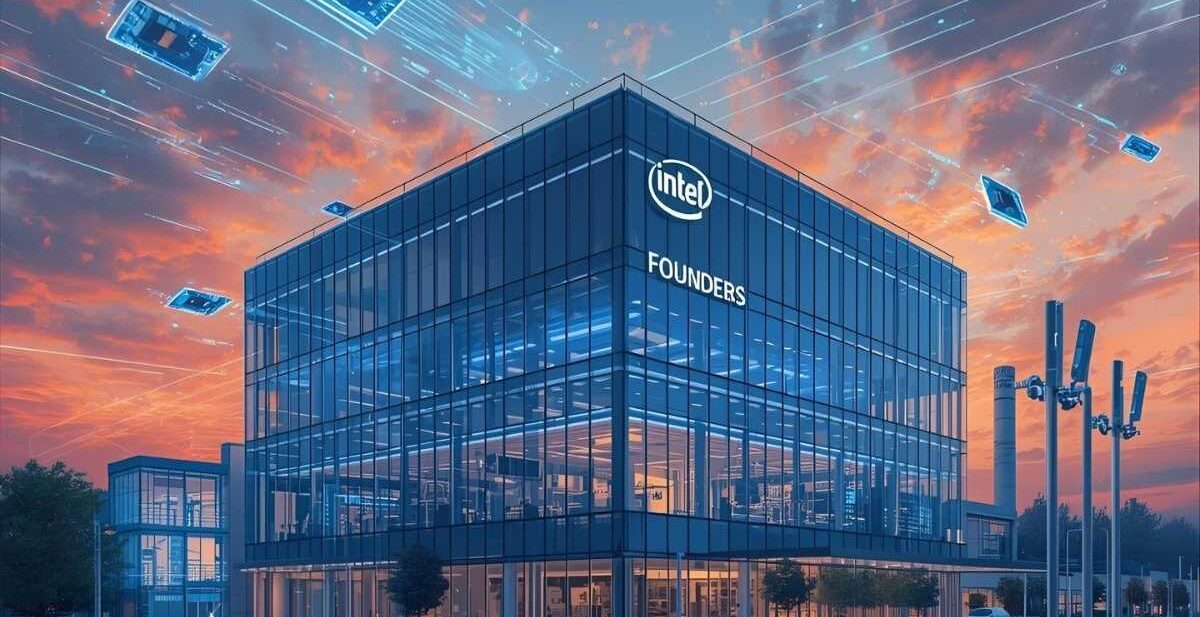
By Carter James | Oplexa Insights
Nov 2025 | 09 Min Read
Intel Foundry Business Takes Bold Leap in the Semiconductor Arena
The semiconductor industry faces intense competition, which is driving the Intel Foundry Business to lead transformative change in the sector’s upcoming developments. Intel has set its sights on becoming the world’s second-largest foundry by 2030 through its fast-paced technological development and worldwide expansion plans. Intel achieved a major manufacturing contract with Microsoft (NASDAQ: MSFT) during the last quarter which belongs to the “Magnificent Seven” group of tech giants. The strategic alliance between Intel and its partners pushed the company’s foundry backlog above $15 billion, marking a critical turning point for Intel to become a leading semiconductor manufacturing company.
Intel Foundry Business Gains Traction with Strong Commitments
The Intel Foundry Business operates as a young division, yet it continues to expand rapidly through its growing market presence. Intel received customer commitments that exceeded $10 billion which establishes a stable revenue flow for its future business operations. Intel maintains its full control of the semiconductor production process through the agreements that cover both chip manufacturing operations and advanced packaging services.
Intel has become a dependable partner for major Cloud Providers and AI companies and data-driven enterprises through its complete ownership of the semiconductor supply chain which includes both silicon fabrication and advanced 3D packaging capabilities. The company demonstrates its dedication to innovation through its strategic direction which will deliver performance efficiency improvements across various industries through GPU developments and 18A process technology advancements.
The Microsoft Deal: A Game-Changer for Intel Foundry Business
Intel reached its critical moment when the company unveiled its major partnership with Microsoft at the Foundry event through the introduction of Intel’s 18A process node for chip production. Intel and its top-tier clients who need high-performance, sustainable semiconductor solutions have entered a new phase of trust after establishing this breakthrough alliance which extends beyond regular contractual agreements.
Microsoft has started building its own custom chips because artificial intelligence usage keeps growing, while data center graphics processing units (GPUs) become increasingly expensive. Microsoft plans to work with Intel Foundry for silicon supply chain control and to reduce Nvidia GPU vendor dependence and boost large-scale data center efficiency.
Powering the Future: The Intel-Microsoft Alliance
- Key Points: Emphasize the focus on AI and cloud computing, the anticipated impact on data center efficiency, and the potential reduction in reliance on Nvidia GPUs.
Powering the Future: The Intel-Microsoft Alliance
The Intel-Microsoft partnership represents a strategic alliance that concentrates on AI development and cloud computing optimization and semiconductor independence for the future. The two technology giants establish a foundation for upcoming data centers which focus on speed optimization and energy efficiency and scalable expansion.
Key Highlights:
AI and Cloud Synergy: The partnership emphasizes the critical intersection of AI, cloud computing, and chip manufacturing.
Enhanced Data Center Efficiency: The design of custom silicon technology enables power optimization which results in improved performance for running large-scale AI workloads in data centers.
Reduced Reliance on GPU Suppliers: The partnership between these companies will help decrease their need for Nvidia GPUs which will create new possibilities for enterprise-grade AI development. infrastructure.
Quotes:
- Intel’s Intel foundry business stands at the forefront of technological innovation. We’re thrilled to partner with Microsoft, driving computing’s future.” – Pat Gelsinger, CEO of Intel
- “Our collaboration with Intel Foundry is a strategic step. It ensures a reliable supply of advanced semiconductors for our evolving infrastructure needs.” – Satya Nadella, CEO of Microsoft
Intel’s Ascent in the Semiconductor Industry
The worldwide semiconductor market undergoes a total transformation as AI systems, autonomous systems, and high-performance computing systems require more power. The semiconductor industry is expected to reach a market value of over $1 trillion by 2030, according to recent reports, which state that foundry services will drive this growth.
Intel’s entry into the contract foundry segment introduces healthy competition in a space long dominated by TSMC and Samsung. The company shows its commitment to national semiconductor targets and global supply chain stability through its investments in American fabrication facilities and sustainable production methods and advanced node technology development.
Conclusion
The Intel Foundry Business operates as a symbol that demonstrates Intel’s transformation from its traditional chip manufacturing operations toward establishing a complete foundry service that caters to worldwide businesses. The Microsoft partnership not only validates Intel’s technological capabilities but also marks a significant milestone in its journey toward reclaiming semiconductor leadership.
AI adoption speed accelerates while cloud providers search for various chip suppliers so Intel’s expanding position in the semiconductor market will create new industry development paths. The next decade will likely see Intel emerging as a central player in shaping the GPU Roadmap, driving sustainable innovation, and expanding the semiconductor industry market size through strategic collaborations and relentless innovation.
FAQs
1. Why is the Intel Foundry Business becoming a major force in the global semiconductor industry?
Intel’s foundry division is gaining momentum because it combines advanced process nodes (like 18A), full-stack manufacturing ownership, and major customer commitments exceeding $10B. Its partnerships with cloud providers and AI giants position Intel as a serious competitor to TSMC and Samsung in the global foundry race.
2. How does the Intel–Microsoft partnership impact the future of AI and cloud infrastructure?
The alliance enables Microsoft to build custom silicon for AI workloads, improve data center efficiency, and reduce dependency on expensive Nvidia GPUs. Intel’s advanced manufacturing and 3D packaging allow Microsoft to scale AI operations with better performance, lower energy usage, and predictable supply chain stability.
3. What makes Intel’s 18A process technology a breakthrough for chip manufacturing?
Intel 18A introduces next-generation RibbonFET transistors and PowerVia backside power delivery, enabling higher performance-per-watt for AI, cloud, and HPC systems. This node is critical for customers needing top-tier efficiency, sustainable computing, and advanced GPU/accelerator designs.
4. What factors are driving growth in the Intel Foundry Business?
Growth is driven by multibillion-dollar customer commitments, expanded fabrication facilities in the U.S., the need for supply chain diversification, rising AI chip demand, and competitive pressure created by new GPU and accelerator requirements. Intel’s control of both silicon and advanced packaging strengthens its global presence.
5. How will Intel’s foundry strategy shape the semiconductor market by 2030?
Intel aims to become the world’s second-largest foundry by 2030. With investments in U.S. fabs, sustainable production, advanced nodes, and major cloud partnerships, Intel will influence the GPU roadmap, increase competitive pressure on TSMC/Samsung, and support the trillion-dollar semiconductor market growth.