- Executive Summary
- Key Insights
- Forecast Highlights
- Strategic Recommendations
-
Introduction
- Purpose of the Report
- Scope & Methodology
- Sources & Assumptions
-
Company Overview & Strategic Position (2025 Snapshot)
- History and Evolution of NVIDIA
- Business Segments (GPU, Data Center, Automotive, AI, Omniverse, Robotics, etc.)
- Organizational Structure & Leadership
- Current Market Valuation and Financial Health (2025)
- Global Presence and R&D Hubs
-
Mega Trends Shaping NVIDIA’s Future (2025–2050)
- Artificial General Intelligence (AGI)
- Quantum Computing Integration
- Semiconductor Supply Chains (TSMC, ASML dependencies)
- Edge AI and Decentralized Compute
- Green AI and Energy-Efficient Compute
- Autonomous Machines & Robotics
- The Metaverse and Omniverse Economy
- Government Policy & Tech Sovereignty
- Ethical AI and Regulation Trends
-
Strategic Roadmap to 2050
- NVIDIA’s Announced Roadmaps (e.g., Blackwell, Rubin, Quantum-AI Initiatives)
- R&D Investment Projections
- Strategic Partnerships and M&A Outlook
- Talent Acquisition & Organizational Capabilities for 2050
-
Opportunity Analysis
- Future Markets (AI, GenAI, Robotics, Climate Tech, Smart Cities)
- NVIDIA in Healthcare and BioAI
- Expansion in Global South and Emerging Markets
- Custom Silicon & Licensing Models
- AI Agents and Developer Ecosystem
-
Risk Analysis
- Geopolitical Tensions (China, US, Taiwan)
- Supply Chain Fragility
- Regulatory & Antitrust Risk
- Competitive Displacement Risk (from open-source or custom silicon)
- Overdependence on Specific Verticals or Clients
- Talent Wars and Brain Drain
-
Competitive Landscape
- AMD, Intel, Apple, Qualcomm
- Startups (e.g., Cerebras, Tenstorrent, SambaNova, Graphcore)
- Cloud Hyperscalers (Amazon, Microsoft, Google custom silicon)
- Open Hardware Threats (RISC-V, Modular GPU, Open Compute)
-
Financial Forecasting to 2050
- Revenue Projections (Segment-wise: Gaming, Data Center, Automotive, etc.)
- Operating Margins and Cost Structures
- Stock Price Forecasts and Market Capitalization Scenarios
- Sensitivity Analysis (best/mid/worst case)
-
NVIDIA’s Role in National and Global Strategy
- Alignment with U.S. National Security & AI Initiatives
- Role in AI Defense & Intelligence
- International Partnerships and Strategic Leverage
-
Technological Ecosystem Analysis
- CUDA, TensorRT, DGX Systems
- AI Model Hosting & Training Infrastructure
- NVIDIA Omniverse, Isaac Platform, Jetson Ecosystem
- SDKs and Software Influence
-
ESG & Sustainability Outlook
- Green Data Centers & Chips
- AI’s Role in Climate Solutions
- Human Rights and Data Ethics
- ESG Ratings & Roadmap to Net-Zero
-
Future Scenarios (2050)
- Scenario 1: Dominance in Global Compute
- Scenario 2: Fragmented AI Landscape
- Scenario 3: Regulatory Disruption & Nationalization
- Scenario 4: Technological Plateau and Open-Source Rise
-
Expert Interviews & Perspectives
- Keynotes from AI Thought Leaders
- Strategic Perspectives from Venture Capital
- Academic Insight on Long-Term AI Futures
-
Strategic Recommendations
- Actions for Investors
- Considerations for Regulators
- Opportunities for Partners & Developers
- Mitigation Strategies for Enterprise Clients
-
Appendices
- NVIDIA Product Timeline (2025–2050)
- Glossary of Terms
- Data Sources and Models
- Detailed Methodology
- References
#AI #NVIDIA #ArtificialIntelligence #Tech #GPU #TechTrends #Innovation #RTX #FutureTech #DigitalTransformation #MachineLearning #DeepLearning #Semiconductor #Gaming #TechNews
Description
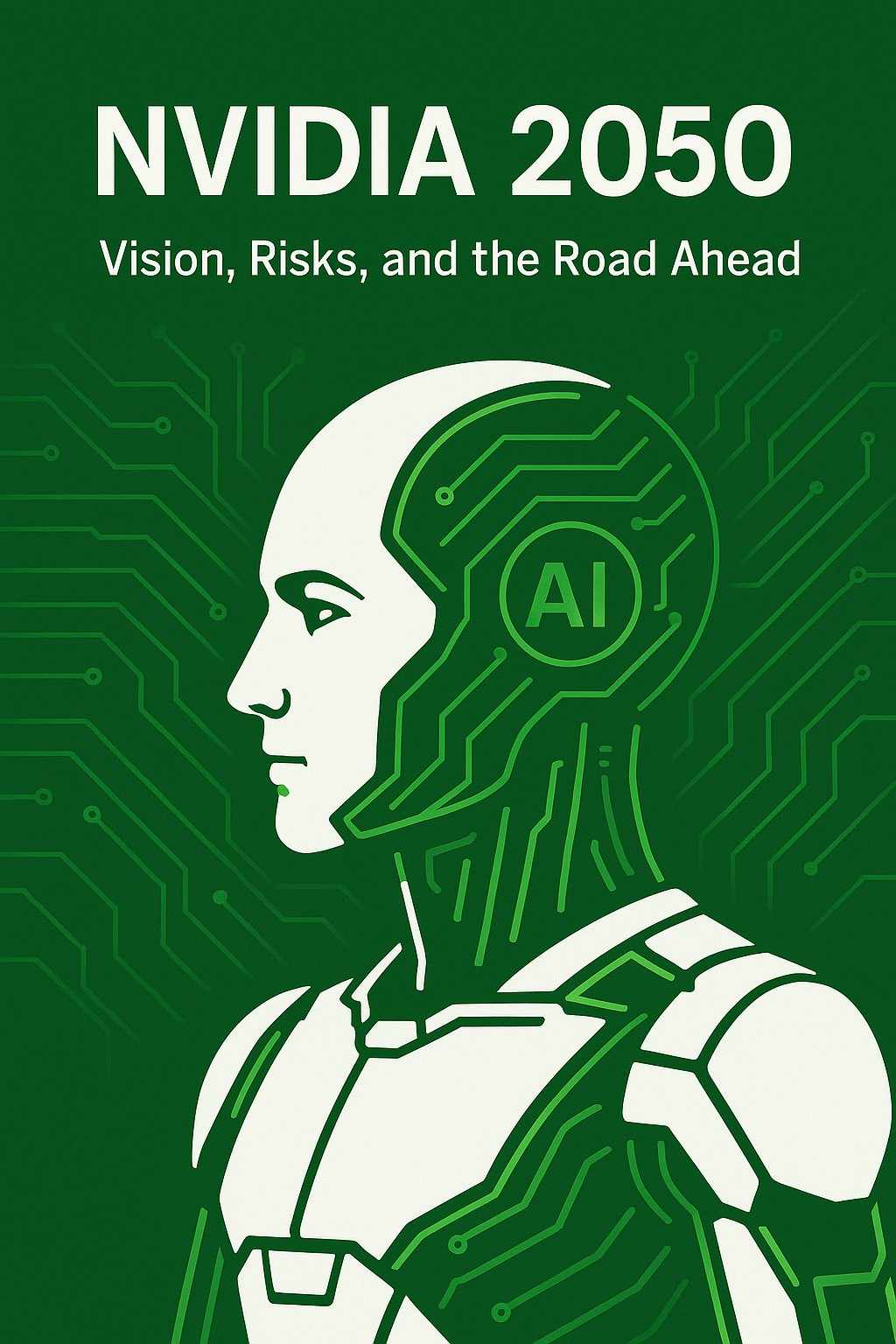
NVIDIA started as a graphics chip manufacturer but has grown into a leading global business that shapes multiple sectors. The path to NVIDIA 2050 brings a defined objective to create modern computing systems and advance AI technology and produce industry-transforming innovations. The path leads to multiple promising destinations yet it contains dangerous obstacles that will determine its future direction.
NVIDIA’s Vision for the Future
The company aims to develop advanced computing systems that will extend beyond traditional graphics technology according to its long-term vision. The company NVIDIA operates to provide power for future intelligent systems, which will include autonomous vehicles and smart urban areas and robotic systems and healthcare applications, and virtual environments.
Artificial intelligence plays a crucial role in shaping this future because it operates as the core technology behind all NVIDIA products and platforms. The year 2050 will bring AI influence to every industry sector and NVIDIA will serve as the fundamental support system for this change. The organization maintains research activities which will support essential IT industry trends that include data-driven decisions and edge computing and automation.
How NVIDIA Reached This Point
NVIDIA established its growth through continuous technological advancements which span multiple decades. The company started as a provider of gaming GPUs but later expanded its operations to include data centers and AI platforms and autonomous systems. The company operates through multiple business segments which include GPUs and automotive solutions and Omniverse and robotics and other areas.
NVIDIA maintains its dominant position in the technology ecosystem through its superior computing power and deep learning framework leadership according to multiple corporate market research studies. The basic framework creates a foundation which will support more extensive plans for the year 2050.
Mega Trends That Will Shape NVIDIA 2050
The organization will experience various worldwide developments which will determine its future path.
- Artificial General Intelligence (AGI) will transform industries through the development of more intelligent, adaptable AI systems.
- Quantum systems when connected with computers will create a new era of advanced computing power.
- The company needs to establish connections with TSMC and ASML to expand its operations according to semiconductor market research findings.
- The world will focus on sustainability as its primary concern because energy needs keep rising.
- Edge AI brings artificial intelligence to the edge of devices which results in faster processing speeds and decreased response times.
- The combination of virtual teamwork with digital twin technology will generate fresh business opportunities according to the Omniverse Economy.
- The trends present various chances for development but they also create different threats to stability. Geopolitical problems would disrupt manufacturing operations yet the fast-changing cybersecurity market research environment needs modern protection methods for data and infrastructure security.
Strategic Roadmap and Opportunities
NVIDIA has established a development plan that focuses on creating enhanced chip designs and fresh platforms and allocating more funds to research activities. The Blackwell and Rubin architectures will provide faster and more efficient computing through their technology. Scientists study quantum-AI integration to discover new opportunities which will lead to revolutionary advancements in various fields.
Future opportunities are not limited to hardware. The organization intends to increase its healthcare operations and bioAI capabilities, and smart infrastructure management. The Global South together with emerging economies will establish themselves as key markets for future expansion. Oplexa states these areas hold special potential for both technological progress and business development.
Risks and Challenges
On the path to 2050, NVIDIA faces several risks despite its strong position:
- Geopolitical conflicts create interruptions which damage both supply networks and worldwide business collaborations.
- The business operations will experience changes because of new regulations and antitrust investigations.
- AMD and Intel along with fresh AI chip companies, will create a more competitive market environment.
- Open-source hardware initiatives could challenge NVIDIA’s dominance.
- The business becomes vulnerable when it depends too much on specific industry sectors or particular customers.
Market research in the technology industry continues to track these risks because businesses and investors and policymakers need to understand them.
Sustainability and Ethics
NVIDIA will probably increase its focus on sustainability in the upcoming years. The development of energy-saving chips and emission reduction in data centers and AI-based climate solutions has started. The future creation and implementation of technology will face challenges from multiple ethical problems which include data protection issues and artificial intelligence discrimination.
The company will operate differently because ESG strategies will create operational changes which will also affect how investors and regulators see the company. These initiatives correspond to the main objectives which Information Technology Industry Analysis Research has established for responsible innovation.
Looking Ahead to 2050
NVIDIA will expand its operations beyond hardware manufacturing during the next 30 years according to current projections. The mission involves creating the digital framework which will operate all future technological systems, including AI medical care and driverless cars and connected urban areas and digital alternative environments.
NVIDIA will define the future of computing through its clear strategic direction and ongoing development of innovative partnerships. The company needs to show strong market agility and deliver value at every stage of global market complexity to achieve success.
The research conducted by Oplexa Market Research together with corporate market studies and cybersecurity market research and semiconductor industry overview indicates that NVIDIA will establish technological leadership which will shape the future from 2050 onward.