


By Carter James | Oplexa Insights
May 2026 | 15 Min Read
Introduction
The Microsoft OpenAI partnership that once defined the AI industry has fundamentally changed. On April 27, 2026, Microsoft and OpenAI announced a restructured agreement that ends years of exclusive cloud dependency, resets financial terms, and opens OpenAI’s models to every major cloud provider on the planet. This is not a breakup. But it is a pivot that every enterprise decision-maker, cloud buyer, and AI investor needs to understand.
For years, if your organization wanted access to GPT-4, ChatGPT Enterprise, or any OpenAI frontier model at scale, you essentially had one option: Microsoft Azure. That exclusivity clause is now gone. OpenAI can now serve all of its products to customers on AWS, Google Cloud, Oracle, or any infrastructure partner it chooses. The implications for enterprise AI strategy, cloud pricing, and competitive dynamics are enormous.
This post breaks down exactly what changed in the Microsoft OpenAI partnership, why it happened, who wins, who loses, and what enterprise teams should do next.
What Actually Changed in the Microsoft OpenAI Partnership
The April 2026 deal restructure touched four major areas. Understanding each one is critical before drawing strategic conclusions.
1. End of Azure Exclusivity
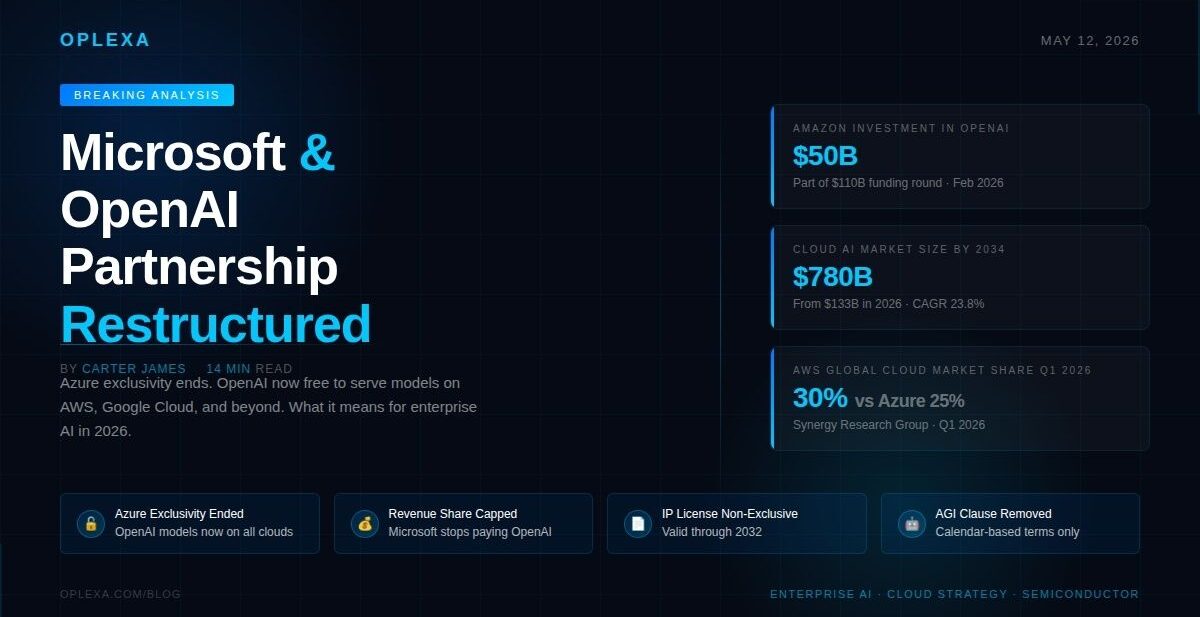
The most significant change is that Microsoft no longer holds exclusive rights to distribute OpenAI’s models and products. OpenAI can now serve all of its products to customers across any cloud provider, including Amazon Web Services and Google Cloud. Previously, this was contractually prohibited.
Microsoft does retain a four-month first-mover window on new frontier model releases. Any new OpenAI model will debut on Azure before it appears on competing clouds. This gives Azure a meaningful head start on each product cycle, but it is no longer an unbreakable moat.
2. Revenue Share Terms Restructured
The financial mechanics of the Microsoft OpenAI partnership also shifted substantially. Microsoft will no longer pay a revenue share to OpenAI. Previously, when enterprise customers accessed OpenAI models through Azure, Microsoft made payments back to OpenAI. That flow has stopped. Meanwhile, OpenAI continues to pay Microsoft a revenue share through 2030 — at the same percentage but now subject to a total cap that neither party has publicly disclosed.
3. Non-Exclusive IP License Through 2032
Microsoft retains a license to OpenAI intellectual property for models and products through 2032. However, this license is now non-exclusive. Other cloud providers and enterprise partners can now negotiate their own licensing arrangements with OpenAI — a structural opening that was not possible under the original agreement.
4. AGI Clause Removed
The original partnership included a complex provision tied to artificial general intelligence milestones. If OpenAI determined it had reached AGI, Microsoft’s contractual rights would have shifted significantly. That clause has been removed entirely. The new agreement operates on calendar dates and financial terms rather than technology milestones — a simpler, more predictable structure for both parties.
Why the Microsoft OpenAI Partnership Changed: The Amazon Factor
To understand why this restructuring happened, you need to trace the Amazon-OpenAI relationship that developed in parallel. In February 2026, Amazon announced an investment of up to $50 billion in OpenAI as part of a $110 billion funding round that valued the company at approximately $840 billion. As part of that deal, OpenAI committed to spending $100 billion on AWS infrastructure over eight years, expanding an existing $38 billion agreement.
AWS also secured the right to serve as the exclusive third-party cloud distribution provider for OpenAI Frontier — the company’s enterprise agent platform. OpenAI committed to deploying 2 gigawatts of Amazon Trainium capacity to support its workloads. For context on why Amazon’s custom silicon matters here and how it stacks up directly against NVIDIA’s Blackwell architecture, read our deep dive: Amazon Trainium 3 vs NVIDIA Blackwell: The $225 Billion Chip Bet.
The February Amazon deal created immediate friction with Microsoft. On the same day OpenAI and Amazon made their announcement, Microsoft issued a public statement insisting that Azure remained the exclusive cloud provider for OpenAI’s stateless APIs. Reports emerged in March 2026 that Microsoft was considering legal action over the apparent conflict with its exclusivity rights.
The April restructuring resolved that legal tension. By formally ending Azure exclusivity, OpenAI cleared the path for the Amazon deal to proceed without triggering a contractual dispute. The Microsoft OpenAI partnership evolved because OpenAI’s commercial ambitions had outgrown the original exclusive structure.
Market Context: The Cloud AI Race in 2026
The restructuring of the Microsoft OpenAI partnership is happening against a backdrop of intense competition for AI infrastructure dominance. The global cloud computing market is valued at $917.9 billion in 2026 and is expected to cross $1 trillion before year-end, according to Gartner. AI-related workloads alone account for 19% of total cloud spending in 2026, up from just 8% in 2023.
Cloud market share data from Synergy Research Group shows AWS leading with 30% of global cloud infrastructure share in Q1 2026, followed by Microsoft Azure at 25% and Google Cloud at 13%. For a detailed breakdown of how these three hyperscalers performed in Q1 earnings — including Azure’s 40% year-over-year growth and AWS’s $364 billion backlog — see our full analysis: Azure vs Google Cloud vs AWS: Who’s Winning the AI Infrastructure Race?
The global cloud AI market is projected to grow from $133.42 billion in 2026 to $780.64 billion by 2034 at a CAGR of 23.8%, according to Fortune Business Insights. This is the prize that every hyperscaler is competing for, and OpenAI’s model distribution is now a key variable in that competition.
Who Wins From the Microsoft OpenAI Partnership Restructure
AWS: The Immediate Beneficiary
Amazon is the most obvious winner. Adding OpenAI’s Frontier platform and stateless APIs to Amazon Bedrock gives AWS a product that previously lived exclusively on Azure. Enterprise customers who preferred OpenAI models but did not want to commit fully to Azure now have a direct AWS path.
William Blair analysts estimated that if OpenAI’s expanded cloud usage approaches $100 billion over multiple years, it implies roughly $17 billion per year of incremental run-rate revenue exposure for AWS. Even at a fraction of that figure, the addition of OpenAI access materially strengthens AWS’s position in competitive enterprise deals against Azure.
Enterprise Customers: Multi-Cloud Becomes Real
Before April 2026, a company that wanted OpenAI’s best models had to route that workload through Azure. This created leverage for Microsoft in broader enterprise negotiations. With OpenAI now available on AWS and soon on Google Cloud, enterprise buyers gain genuine negotiating flexibility for the first time.
According to the Flexera 2026 State of the Cloud Report, 87% of enterprises already run multi-cloud strategies and 73% operate hybrid cloud estates. The end of Azure exclusivity aligns OpenAI’s distribution with how enterprise IT actually operates in the real world.
OpenAI: Commercial Freedom Ahead of IPO
OpenAI’s revenue chief Denise Dresser stated in an internal memo that the exclusive Azure arrangement had “limited our ability to meet enterprises where they are.” The restructured Microsoft OpenAI partnership removes that constraint entirely. OpenAI is targeting a public market debut with a potential trillion-dollar market cap by Q4 2026 — and the commercial freedom created by this restructuring directly supports that valuation narrative.
Who Faces New Pressure
Microsoft Azure: Competing on Merit
Azure loses the contractual guarantee that brought OpenAI customers to its platform by default. However, Azure remains OpenAI’s primary cloud partner, retains the four-month first-mover window on new model releases, and holds the exclusive route for customers wanting OpenAI models integrated with Microsoft’s security, compliance, and productivity stack serving 400 million Microsoft 365 users.
Azure grew 40% year-over-year in Q1 2026. It is not a platform in distress. But it must now compete on the merit of its integrations and pricing rather than exclusivity alone.
The Semiconductor Layer Underneath It All
This shift in cloud distribution has direct implications for the chip market. OpenAI’s commitment to 2 gigawatts of Amazon Trainium capacity is one of the largest custom silicon commitments in history. Meanwhile, NVIDIA recently crossed the $5 trillion market cap milestone — the first semiconductor company to do so — as demand for AI accelerators surges across every major cloud. For the full picture of where AI compute investment is heading through 2035, our Global AI Chip Market Analysis & Forecast maps hyperscaler chip strategy across NVIDIA, AMD, Amazon Trainium, Google TPU, and emerging custom silicon players.
Mid-Tier AI Platforms
As OpenAI’s direct enterprise reach expands across multiple clouds, platforms that built their value proposition partly on simplifying access to OpenAI models face increased pressure to differentiate. The long-term consolidation trend in enterprise AI tooling is accelerating.
What Enterprise Teams Should Do Now
The restructuring of the Microsoft OpenAI partnership does not require enterprises to change everything immediately. But it creates three strategic moves worth acting on.
Re-evaluate your cloud negotiating leverage. If your organization has been locked into Azure pricing partly because of OpenAI dependency, the new multi-cloud availability of OpenAI models gives you a genuine alternative to negotiate against before your next renewal cycle.
Assess your AI model portfolio. Anthropic’s enterprise market share jumped from 12% to 32% in 2025 as organizations began optimizing for price-performance rather than single-vendor lock-in. OpenAI’s broader availability may slow switching but does not reverse the underlying move toward model diversification. Organizations that have not yet mapped AI workloads to specific model strengths are already behind.
Watch the OpenAI IPO timeline. How OpenAI performs across multi-cloud distribution over the next two quarters will be a key signal for its IPO readiness and valuation. Enterprise teams that become anchor customers on AWS or Google Cloud before the IPO may gain commercial advantages as OpenAI aggressively grows its customer base ahead of going public.
Conclusion
The restructured Microsoft OpenAI partnership is one of the most consequential shifts in enterprise AI since the original deal was signed in 2019. It ends Azure’s monopoly on OpenAI distribution, frees OpenAI to grow commercially across every major cloud platform, and gives enterprise buyers genuine negotiating leverage for the first time.
Microsoft is not losing its position as a premier AI platform. Azure’s integrations, compliance stack, and 400 million daily Microsoft 365 users are durable advantages. But those advantages now need to be earned on merit, not protected by contract.
For enterprises, the message is straightforward: the Microsoft OpenAI partnership restructure expands your options. Whether you act on that immediately or not, understanding the new competitive landscape is the baseline requirement for any AI infrastructure decision made in 2026.
Stay ahead of AI infrastructure and semiconductor market shifts. Subscribe to Oplexa Insights for weekly analysis on enterprise AI, cloud strategy, and the chips powering the AI economy.