1. Executive Summary
-
- Key Insights on InfiniBand and Ethernet in Data Centers
- Overview of Market Size and Growth Projections
- Key Market Drivers: AI, HPC, and Cloud Data Centers
2. Industry Overview
-
- Definition and Role of InfiniBand and Ethernet in Data Center Networking
- Historical Overview and Technological Evolution
- Key Application Areas: High-Performance Computing (HPC), Enterprise Data Centers, Cloud Providers
3. Market Segmentation
-
- InfiniBand vs. Ethernet in Different Data Center Types (Hyperscalers, Enterprise, Colocation)
- Vertical Market Adoption: AI Workloads, Financial Services, Research Institutions
- Geographical Market Breakdown and Trends
4. Market Share Analysis
-
- Global Market Share of InfiniBand and Ethernet (2025-2035 Projections)
- Key Players in the Market (NVIDIA/Mellanox for InfiniBand, Cisco, Arista, Broadcom for Ethernet)
- Factors Driving the Market Share Shifts (Cost, Performance, Scalability)
5. Technology Comparison
-
- Performance Metrics: Bandwidth, Latency, Scalability
- Cost-Benefit Analysis of InfiniBand vs. Ethernet
- Use Case Analysis: Where InfiniBand Excels (HPC, AI), Where Ethernet Dominates (General-Purpose, Enterprise Networking)
6. Future Trends and Developments
-
- Emerging Networking Technologies: 800G, 1.6T Ethernet
- AI and Machine Learning’s Impact on Networking Needs
- Future Outlook for InfiniBand and Ethernet in Data Centers
7. Customer Dynamics
-
- Key Purchase Criteria: Cost, Performance, Scalability, Ecosystem Support
- Adoption Trends Among Hyperscalers and Enterprise Data Centers
- Customer Segmentation by Industry (Cloud, Financial Services, Research Labs)
8. Competitive Landscape
-
- Key Players in InfiniBand and Ethernet Markets: NVIDIA, Cisco, Arista, Broadcom
- Strategic Initiatives: Product Development, Mergers & Acquisitions, Partnerships
- Market Entry Barriers and Opportunities for New Entrants
9. Financial Outlook and Projections
-
- Revenue Projections for InfiniBand and Ethernet Solutions (2025-2035)
- Capital Investment Trends in Data Center Networking
- ROI Analysis for Adopting InfiniBand vs. Ethernet
10. Conclusion
-
- Strategic Recommendations for Data Center Networking Providers
- Market Disruptors to Watch
- Long-term Outlook for InfiniBand and Ethernet in Data Centers
11. Appendix
-
- Data Charts, Tables, and Graphs Illustrating Market Trends and Financial Projections
- Detailed Breakdown of Market Share and Performance Metrics
#InfiniBand #Ethernet #DataCenters #AIWorkloads #HPC #CloudDataCenters #NetworkPerformance #InfiniBandVsEthernet #DataCenterNetworking #Hyperscalers #EnterpriseDataCenters #Colocation #TechTrends #NetworkingTechnologies #800GEthernet #1600GEthernet #Bandwidth #Latency
Description
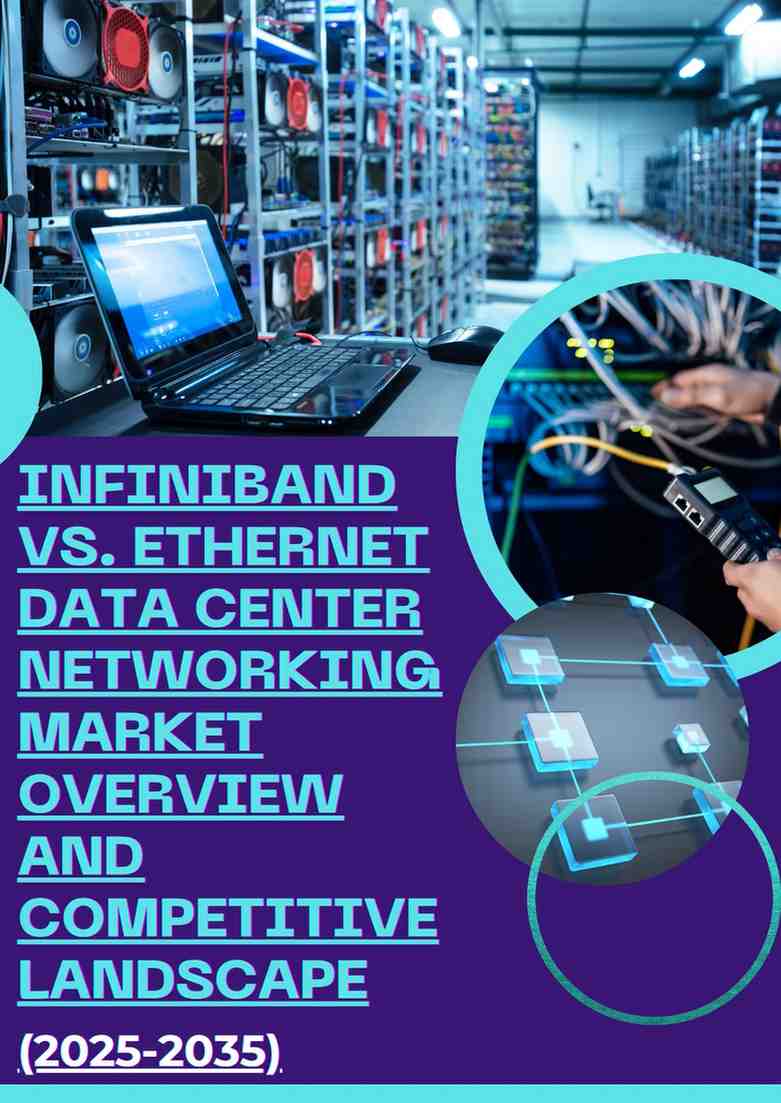
The market keeps producing continuous discussion about InfiniBand vs Ethernet and which technology delivers better results for high-performance data centers. The ongoing expansion of AI and HPC (High-Performance Computing) and Cloud Providers has transformed networking technology selection into a vital strategic choice for organizations. The Market Research and Corporate Market Research reports predict that network requirements for enhanced speed and scalability will experience substantial growth from 2025 through 2035.
Why This Battle Matters
Data centers function as storage facilities that power AI models and run the best vector database and perform financial simulations and support ca loud-native SaaS strategy. The network fabric needs to provide both fast data transfer speeds and wide bandwidth capacity because of increasing workload complexity. The two technologies follow distinct paths at this point.
- The system design of InfiniBand focuses on achieving high-speed data transmission and superior operational performance.
- Ethernet technology provides organizations with financial savings and adaptable network systems.
- The two systems serve distinct purposes but the development of AI and GPU clusters continues to alter their operational equilibrium.
Market Size and Growth Outlook
Driven by the semiconductor industry market size growth and increased Capital Expenditure in infrastructure, data center networking is entering its most transformative decade. The Semiconductor Manufacturing Industry and semiconductor industries in the USA are fueling demand for high-speed interconnects to support chip design, modeling, and GPU computing.
Looking ahead, NVIDIA’s GPU Roadmap and long-term vision (even concepts like NVIDIA 2050) suggest that data centers will need faster fabrics to unlock next-gen computing performance. This directly accelerates the adoption of both high-speed Ethernet and advanced InfiniBand.
InfiniBand vs Ethernet: Where Each One Wins
InfiniBand Advantages:
- The technology provides extremely fast communication speed.
- High bandwidth (NDR, XDR, 800G+)
- The system provides an ideal environment for training AI models and running HPC workloads and GPU clusters.
- Used in supercomputers and research labs
Ethernet Advantages:
- The technology has become widely accepted throughout the industry while remaining budget-friendly.
- The system provides a simple way to expand its capabilities throughout large enterprise networks and cloud-based environments.
- Strong vendor ecosystem (Cisco, Arista, Broadcom)
- The industry moves at high speed to implement 800G and 1.6T Ethernet technology.
Hyperscalers (AWS, Google, Microsoft)
The core networking system operates through Ethernet technology while InfiniBand or RoCE serves as the preferred choice for AI/ML cluster connectivity in this hybrid model.
Enterprises
The primary choice for standardization and operational ease and budget management is Ethernet technology.
Research Labs and HPC
The system operates through InfiniBand technology to achieve its fastest data transfer rates and lowest network delay.
Financial Services
The system operates with two network types which use Ethernet for basic operations and InfiniBand to support high-speed low-delay trading activities.
Geographic Adoption and Trends
USA and China lead due to AI and semiconductor investments.
Europe dedicates its main attention to high-performance computing (HPC) and environmental sustainability projects.
The Asia-Pacific region experiences
Market Share Outlook (2025–2035)
Ethernet will keep its position as the leading market leader because of its high production numbers and affordable pricing but InfiniBand will experience rapid expansion within AI and HPC sectors. Strategic vendors are driving this shift:
InfiniBand: NVIDIA (Mellanox)
Ethernet: Cisco, Arista, Broadcom
Financial and Strategic View
As data center Capital Expenditure rises, organizations analyze ROI based on workload type:
Cloud Providers are also reshaping the market. Their SaaS strategy depends on fast, reliable, and scalable networks, often blending both technologies.
Future Trends to Watch
-
800G and 1.6T Ethernet becoming mainstream
-
AI-native networking chips
-
Convergence of Ethernet with RDMA to mimic InfiniBand performance
-
Growth of GPU clusters based on NVIDIA’s GPU Roadmap
-
Increased demands from the Semiconductor Manufacturing Industry
Final Outlook
The competition between InfiniBand and Ethernet will not decide future directions because these two technologies need to work together in strategic ways. Data centers that unite high-speed InfiniBand fabrics for AI/HPC with scalable Ethernet for cloud and enterprise workloads will emerge as the leading winners during the next ten years.
The modern world requires a networking strategy that combines hybrid approaches with systems that optimize performance and maintain readiness for future developments.