


By Mitthan Meena | Oplexa Insights
Mar 2026 | 18 Min Read
Everyone is watching NVIDIA. Nobody is watching the company that makes NVIDIA possible.
Samsung just delivered what may become the most consequential quarterly result in semiconductor history. The Samsung memory chip AI supercycle is no longer a forecast — it is a confirmed financial reality. With Q1 2026 operating profit projected at $26.9 billion — nearly six times the same period last year — the numbers are telling investors something that most analysts are only beginning to understand: the AI boom has permanently restructured the global memory market, and Samsung sits at its center.
This is not just a story about one company having a good quarter. The Samsung memory chip AI surge reflects a fundamental, multi-year shift in how artificial intelligence infrastructure is built, funded, and supplied. DRAM prices rose 51% in a single quarter. HBM4 production is already sold out for the year. And Samsung is just getting started.
In this analysis, we break down exactly what happened, why it matters, and what it means for investors, enterprises, and the broader semiconductor supply chain through 2027.
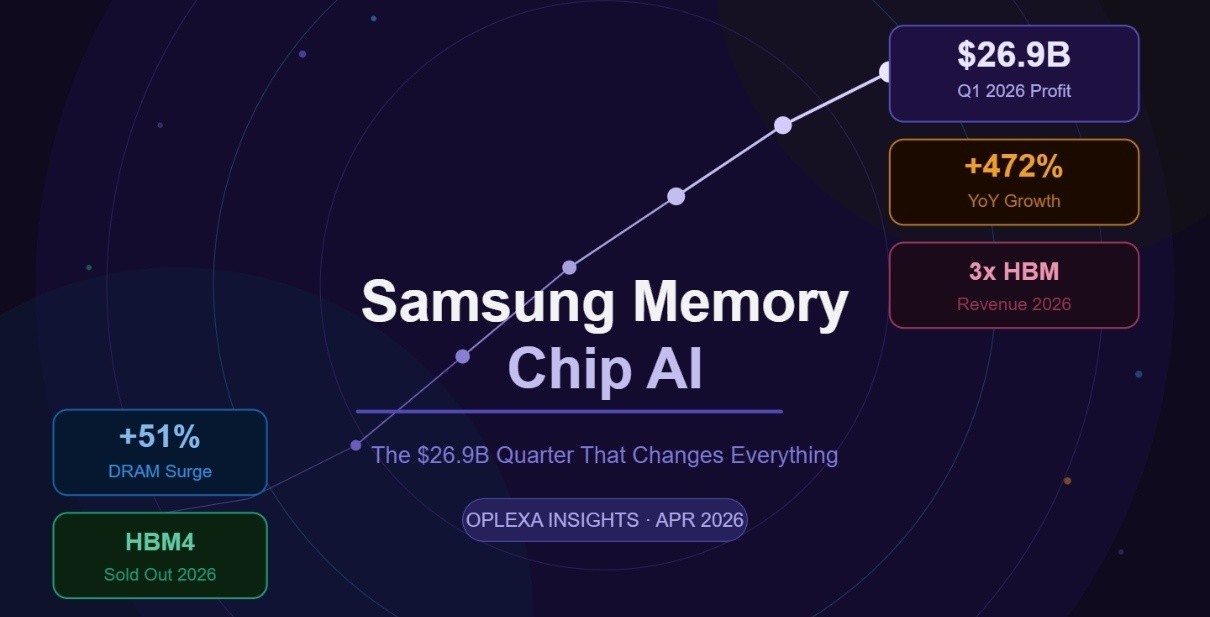
| $26.9B | Projected Q1 2026 Operating Profit — Near 6x Year-over-Year |
| +51% | DRAM Price Increase — Q1 2026 Quarter-on-Quarter |
| 3x | Samsung HBM Revenue Growth Expected in 2026 vs 2025 |
1. What Just Happened: The Samsung Memory Chip AI Supercycle Explained
The Samsung memory chip AI supercycle did not arrive overnight. It has been building since late 2024, when hyperscalers — Google, Microsoft Azure, Meta, and Amazon — began committing hundreds of billions of dollars to AI infrastructure buildouts. Every one of those data centers requires three things: compute chips (GPUs/ASICs), networking silicon, and memory.
Memory was always the quiet part of this equation. While the world debated NVIDIA vs AMD and custom silicon strategies, memory producers were silently becoming the most critical bottleneck in the entire AI supply chain.
Here is the core dynamic that drives the Samsung memory chip AI supercycle:
High-Bandwidth Memory (HBM) is required for every NVIDIA Blackwell Ultra and Vera Rubin GPU. Each next-generation AI accelerator rack requires massive quantities of HBM4 stacked directly on the chip package.
HBM production consumes roughly three times the wafer capacity of standard DRAM. This means that as Samsung, SK Hynix, and Micron shift capacity toward AI-grade memory, supply for conventional DRAM collapses — driving prices up across the board.
The Samsung memory chip AI advantage is compounding. Samsung confirmed it will begin commercial deliveries of HBM4 — featuring 11.7 Gbps industry-leading performance — to NVIDIA and Google this quarter. Analysts at CLSA project Samsung’s total HBM shipments to triple in 2026.
💡 Why Samsung Memory Chip AI Matters More Than NVIDIA Stock NVIDIA designs the chips. Samsung manufactures the memory that makes them work. Without Samsung HBM4, NVIDIA cannot ship Vera Rubin at scale. This supply dependency is why the Samsung memory chip AI story is arguably more investable than NVIDIA itself at current valuations.
2. The Numbers: Breaking Down Samsung’s Historic Q1 2026 Results
Let’s be precise about what the Samsung memory chip AI supercycle has produced financially:
| Metric | Q1 2025 | Q1 2026 (Projected) | Change |
|---|---|---|---|
| Operating Profit | ~$4.7B | ~$26.9B | +472% YoY |
| Revenue | ~$43B | ~$65B+ | +50% YoY |
| DRAM Price Change | Declining | +51% QoQ | Supercycle |
| NAND Price Change | Declining | +48% QoQ | Supercycle |
| HBM Revenue | Baseline | 3x YoY | Tripling |
| HBM4 Status | Not available | Shipping Q1 | Market leader |
The numbers confirm what many in the Samsung memory chip AI market have been predicting: this is not a temporary price spike. It is a structural supercycle driven by AI infrastructure demand that will persist through at least 2027, according to multiple major brokerages.
KB Securities projects Samsung’s full-year 2026 operating profit at 123 trillion won. Macquarie Equity Research forecasts the global DRAM market alone will reach $311 billion in 2026 — approximately six times its size in 2023. TrendForce expects server DRAM contract prices to rise by a further 60% through at least Q2 2026.
💡 The PC and Smartphone Tax The Samsung memory chip AI supercycle has a hidden cost: consumers buying laptops and smartphones in 2026 are effectively subsidizing AI infrastructure. As Samsung reallocates wafer capacity toward high-margin AI memory, DRAM and NAND supply for consumer devices tightens — pushing up prices for everyone.
3. HBM4: Why Samsung Memory Chip AI Dominance Is Just Beginning
The most important development in the Samsung memory chip AI story is not Q1 2026 results — it is what comes next.
HBM4 is the next generation of high-bandwidth memory designed specifically for NVIDIA’s Vera Rubin and Blackwell Ultra platforms, Meta’s MTIA v3, and Google’s TPU v7. Samsung memory chip AI positioning in HBM4 is strategically critical:
| HBM Generation | Performance | Target Platform | Samsung Status |
|---|---|---|---|
| HBM3E | 8 Gbps | NVIDIA H200, Blackwell | Mass production |
| HBM4 | 11.7 Gbps | NVIDIA Rubin, Blackwell Ultra | Shipping Q1 2026 |
| HBM4E | 15+ Gbps (est.) | NVIDIA Feynman (2028) | Development phase |
| HBM5 | 20+ Gbps (est.) | Post-2028 AI accelerators | Research phase |
Samsung has confirmed its HBM4 product featuring 11.7 Gbps performance will ship commercially to major customers — including NVIDIA and Google — in Q1 2026. This is a direct competitive challenge to SK Hynix, which has dominated the high-end Samsung memory chip AI supply chain for the past two years.
The competitive dynamics matter enormously. SK Hynix described its HBM, DRAM, and NAND capacity as essentially sold out for 2026. Samsung entering the HBM4 market at volume does not ease the supply shortage — because demand is growing faster than any producer can add capacity.
📊 Global Semiconductor Supply Chain Risk & Forecast 2025–2035 — $299 Full analysis of HBM supply constraints, Samsung vs SK Hynix vs Micron competitive dynamics, and semiconductor supply chain risk scenarios through 2035. Essential reading for investors tracking the Samsung memory chip AI opportunity. Access Report →
4. The AI Memory Market: How Big Is the Samsung Memory Chip AI Opportunity?
To understand the scale of the Samsung memory chip AI opportunity, you need to look at the total addressable market — not just for HBM, but for the entire AI-driven memory ecosystem:
| Memory Segment | 2023 Market Size | 2026 Forecast | CAGR |
|---|---|---|---|
| DRAM (Total) | $52B | $311B | ~80% (2-yr) |
| HBM Specifically | $4B | $35B+ | ~190% (2-yr) |
| Enterprise SSD (AI) | $18B | $48B | ~70% (2-yr) |
| NAND Flash (AI) | $25B | $65B | ~60% (2-yr) |
| Total AI Memory TAM | $99B | $459B+ | ~66% (2-yr) |
These numbers are not from fringe analysts. The DRAM market forecast of $311 billion in 2026 comes from Macquarie Equity Research. The HBM tripling projection comes from CLSA. The Samsung memory chip AI opportunity is confirmed by multiple independent sources across the institutional research ecosystem.
The reason this matters for investors is simple: the Samsung memory chip AI supercycle is not priced into most portfolio strategies. While NVIDIA has attracted enormous attention, Samsung trades at a fraction of the valuation premium — despite being the critical supplier that makes the entire AI hardware buildout possible.
💡 The Helium Risk Nobody Is Talking About Middle East tensions have pushed helium spot prices up by over 50% in recent weeks. Helium is a critical resource in semiconductor manufacturing — used in chip fab cooling and NAND production. A sustained helium supply disruption could slow Samsung memory chip AI production timelines significantly, even if demand remains strong.
5. Samsung vs SK Hynix vs Micron: The Three-Way Memory War
The Samsung memory chip AI market is not a monopoly — it is a high-stakes three-way competition between Samsung, SK Hynix, and Micron. Each player is making massive capital commitments to capture AI memory demand:
| Company | 2026 CapEx | HBM Status | Key Advantage |
|---|---|---|---|
| Samsung | $73B+ total investment | HBM4 shipping Q1 2026 | Scale + foundry integration |
| SK Hynix | Capacity sold out 2026 | HBM3E dominant, HBM4 in dev | First mover, NVIDIA preferred |
| Micron | $25B+ CapEx 2026 | HBM4 36GB 12H production | US-based, CHIPS Act beneficiary |
The key question for investors is whether Samsung can recapture HBM market share from SK Hynix, which has been NVIDIA’s preferred Samsung memory chip AI supplier for the past two generations of accelerators. The answer appears to be yes — but the timeline matters. CLSA projects Samsung’s HBM shipments to triple in 2026, suggesting the company is rapidly closing the gap.
For context: Samsung’s total 2026 investment in semiconductor manufacturing exceeds $73 billion. This level of capital commitment signals confidence in the Samsung memory chip AI cycle that extends well beyond 2026.
📊 AI Chip Market Analysis & Forecast 2025–2035 — $299 Comprehensive breakdown of the AI memory market, HBM competitive dynamics, Samsung vs SK Hynix vs Micron positioning, and 10-year investment outlook. The essential reference for understanding the Samsung memory chip AI opportunity. Access Report →
6. What the Samsung Memory Chip AI Supercycle Means for Enterprise Buyers
The Samsung memory chip AI supercycle is not just an investor story. Enterprise technology buyers are facing a direct financial impact that is reshaping procurement strategies across every industry.
Server Memory Costs Are Doubling: Enterprise server DRAM prices rose more than 60% in Q1 2026. Companies building or expanding AI infrastructure are facing memory costs that are 2-3x what they budgeted 18 months ago. The AI pricing pressure on Samsung memory chips is directly impacting AI total cost of ownership calculations for every enterprise deploying large language models.
AI PC and Workstation Memory Premiums: As Samsung redirects capacity toward AI server memory, DRAM supply for consumer and commercial PCs tightens. Enterprise IT teams are reporting that workstation and laptop memory has become harder to source and significantly more expensive — a direct consequence of the AI reallocation of Samsung memory chips.
Cloud Pricing Implications: AWS, Azure, and Google Cloud are absorbing higher Samsung memory chip AI costs at the infrastructure level. Analysts project cloud AI compute pricing will increase 15-25% through 2026 as hyperscalers pass through higher hardware costs. Enterprise AI budgets need to account for this structural price increase.
💡 The $7M Enterprise AI Spend Reality The average enterprise LLM spend reached $7 million per company in 2026 — and memory costs now represent a significant and growing share of that figure. Understanding the Samsung memory chip AI pricing cycle is essential for enterprise AI budget planning through 2027.
7. Risks to the Samsung Memory Chip AI Thesis
No investment thesis is complete without examining the risks. The Samsung memory chip AI supercycle faces several credible challenges:
| Risk | Probability | Impact | Mitigation |
|---|---|---|---|
| AI capex slowdown | Low-Medium | High | Multi-year commitments already locked |
| Geopolitical: Taiwan/Korea disruption | Low | Very High | Geographic diversification ongoing |
| HBM4 qualification delays | Medium | Medium | Multiple customers qualifying simultaneously |
| China export control expansion | Medium | Medium | Samsung diversifying customer base |
| Helium/materials shortage | Medium | Medium | Alternative supply chains being developed |
| New entrant (Yangtze Memory) | Low (near-term) | Low-Medium | Technology gap 5-10 years per experts |
The most credible risk to the Samsung memory chip AI thesis is a sudden slowdown in AI infrastructure investment. However, with hyperscalers having already committed over $720 billion in AI capital expenditure through 2026-2027, a near-term reversal appears unlikely. The purchase orders are locked. The supply constraints are structural.
8. Investment Takeaways: What the Samsung Memory Chip AI Story Means for Your Portfolio
The Samsung memory chip AI supercycle presents multiple layers of investment opportunity — direct and indirect:
Direct Plays Samsung Electronics (005930.KS / SSNLF): The direct beneficiary. Trading at a significant discount to NVIDIA despite being the critical supplier in the AI hardware stack. SK Hynix (000660.KS): NVIDIA’s preferred HBM supplier. First-mover advantage in HBM3E, developing HBM4. Micron Technology (MU): US-based Samsung memory chip AI beneficiary. CHIPS Act subsidies + HBM4 mass production beginning.
Indirect Plays ASML (ASML): The only company that makes EUV lithography machines used to produce advanced Samsung memory chip AI products. SK Hynix just placed an $8 billion order. NVIDIA (NVDA): The primary demand driver for HBM4. Samsung memory chip AI supply determines Nvidia’s ability to ship Vera Rubin at scale. Broadcom (AVGO): Custom AI accelerators for hyperscalers all require Samsung memory chip AI infrastructure — HBM supply is critical to Broadcom’s $100B forecast.
The Single Most Important Takeaway: The Samsung memory chip AI supercycle is the most powerful evidence yet that the AI infrastructure boom is structural, not cyclical. Six-times year-over-year profit growth does not happen in a temporary demand spike. It happens when a fundamental, multi-year infrastructure buildout collides with constrained supply. That is exactly what is happening — and it is far from over.
📊 The Inference War: Margin Compression & AI Market Dynamics 2026–2028 — $1,499 Deep-dive analysis of AI infrastructure economics including memory cost impact on inference margins, Samsung HBM4 supply scenarios, and investment positioning through 2028. Built for institutional investors and enterprise AI leads. Access Report →
Conclusion
The numbers from Q1 2026 make one thing undeniable: the Samsung memory chip AI supercycle is real, it is structural, and it is accelerating. A near-record $26.9 billion operating profit, DRAM prices up 51%, HBM4 sold out before it even shipped — these are not the numbers of a temporary demand cycle.
They are the numbers of an industry that has been permanently restructured by artificial intelligence.
For investors, the Samsung memory chip AI story offers a compelling entry point into AI infrastructure at a valuation discount to pure-play chip companies. For enterprises, it is a clear signal that AI hardware costs will remain elevated — and that supply chain strategy matters more than ever.
The companies that understand the Samsung memory chip AI dynamics — and position accordingly — will have a significant advantage through 2027 and beyond. For deeper research and market intelligence on AI infrastructure, visit Oplexa — AI and semiconductor market research built for investors and enterprise leaders.
FAQ
Why is the Samsung memory chip AI supercycle happening now?
The Samsung memory chip AI supercycle is being driven by unprecedented AI infrastructure investment from hyperscalers. Every AI accelerator requires HBM — and HBM production consumes 3x the wafer capacity of standard DRAM. As demand for AI chips accelerates, memory producers like Samsung must shift capacity toward HBM, creating cascading supply shortages and price surges across the entire DRAM and NAND market.
How long will the Samsung memory chip AI price surge last?
Multiple independent analysts — including Macquarie, CLSA, and TrendForce — project Samsung memory chip AI pricing to remain elevated through at least H1 2027. The fundamental driver is demand growing faster than any producer can add capacity. Samsung’s own capital commitments suggest the company expects the supercycle to persist beyond 2028.
What is HBM4 and why does it matter for Samsung?
HBM4 (High Bandwidth Memory 4) is the next generation of AI-grade memory, delivering 11.7 Gbps performance — a significant improvement over HBM3E. Samsung memory chip AI positioning depends critically on HBM4 because it is the required memory for NVIDIA’s Vera Rubin and Blackwell Ultra platforms, which represent the next generation of AI accelerators beginning to ship in 2026.
How does Samsung memory chip AI demand affect enterprise IT budgets?
Enterprise server DRAM prices rose more than 60% in Q1 2026. Companies building AI infrastructure are facing significantly higher hardware costs, and cloud providers are beginning to pass those costs through in the form of higher AI compute pricing. Enterprise AI budget planning should account for a 15-25% increase in infrastructure costs through 2026.
Where can I find deeper data on the AI memory and semiconductor market?
Oplexa’s Global Semiconductor Supply Chain reports and AI Chip Market Analysis reports provide comprehensive data on the Samsung memory chip AI market, HBM competitive landscape, and investment positioning through 2035. All reports are available at oplexa.com/market-research.