


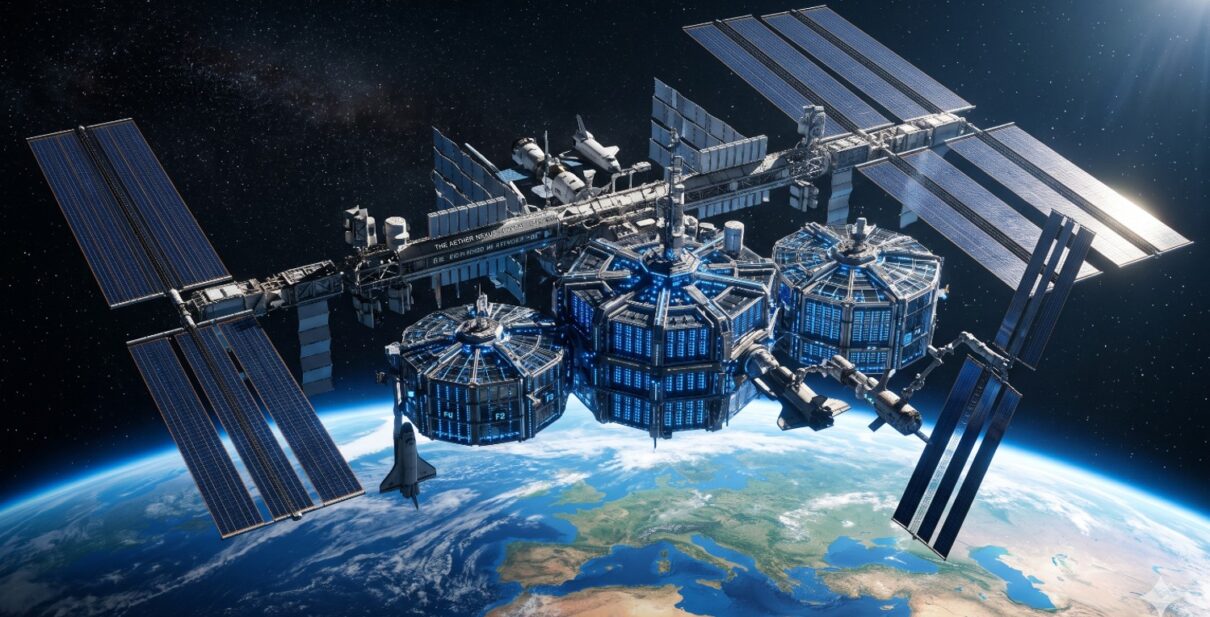
Exploring the Future of Orbital AI Infrastructure and Space-Based Computing
Cover Illustration: Data Centers in the Sky
Author: Oplexa LLC Technology Research Division | Published By: Oplexa LLC | Reading Time: ~25 min
Introduction
What if tomorrow’s AI infrastructure wasn’t built in Arizona or Iceland—but in Low Earth Orbit?
Could the next hyperscale cloud region exist above our atmosphere? For decades, the standard approach to scaling computing power has been simple: buy more land, build a larger warehouse, and plug into the local power grid. But as artificial intelligence integrates into every facet of enterprise decision-making, the terrestrial infrastructure supporting these ambitions is reaching its physical and environmental limits.
We are rapidly approaching a bottleneck where the progress of digital transformation could be constrained by planetary resources. To overcome this, visionary engineers and technologists are looking upward. “Data Centers in the Sky”—the concept of deploying server farms into Earth’s orbit—represents an emerging frontier in cloud architecture. By leveraging the vacuum of space, near-continuous access to high-intensity solar energy in carefully selected orbital configurations, and high-bandwidth laser communications, researchers envision a new paradigm for scalable AI workloads.
Editorial Note: While the concepts discussed in this article draw upon active aerospace research and current orbital edge computing deployments, many of the hyperscale architectures proposed represent future-oriented, exploratory frameworks rather than existing, widely available commercial services.
“The next cloud region may not be defined by geography, but by orbital mechanics.”
The Evolution of AI Infrastructure
To truly grasp the magnitude of moving infrastructure into orbit, it helps to view the evolution of computing as a continuous escape from physical boundaries. We began with room-sized mainframes isolated in academic basements, moved to distributed terrestrial data centers, and currently rely on sprawling hyperscale facilities located in specialized climate zones.
Now, as AI workloads transition from predictive algorithms to generative intelligence and autonomous reasoning, the constraints are no longer just real estate—they are fundamental physics. Edge computing successfully decentralized processing, pushing it closer to the user, but orbital computing takes the “edge” into the vacuum of space.
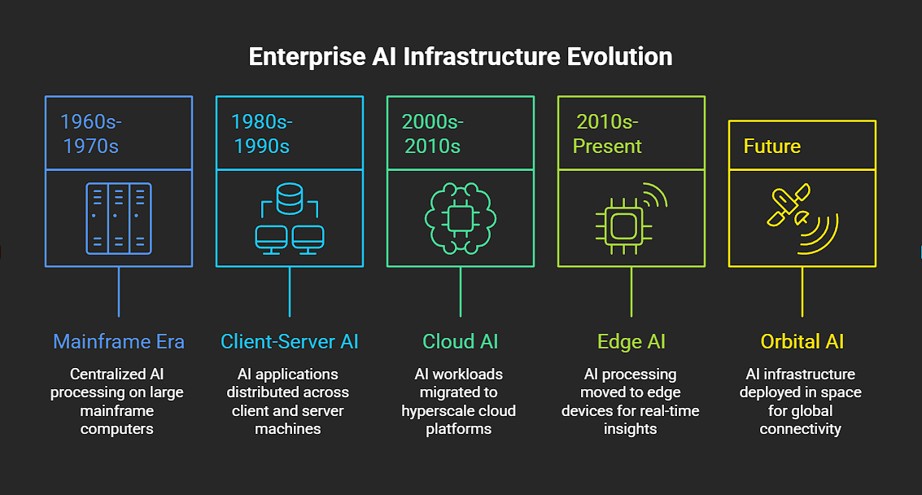
Infographic 1: AI Infrastructure Evolution
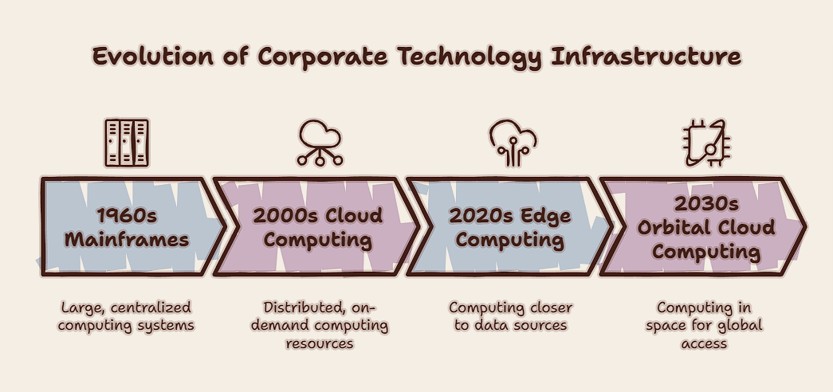
A visual timeline mapping the progression from 1960s mainframes to 2000s cloud hyperscalers, 2020s edge deployments, and the projected 2030s shift toward orbital cloud computing.
Figure 2: AI GPU Clusters
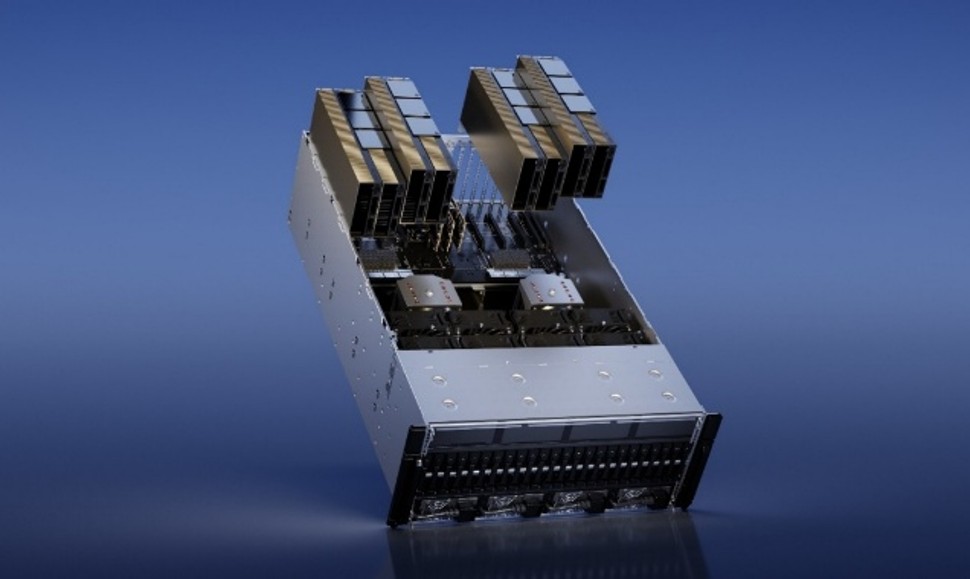
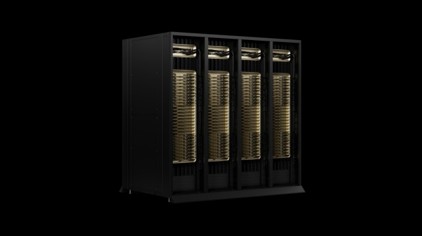
Figure 3: Enterprise AI Evolution Timeline
Why AI Is Pushing Earth-Based Infrastructure to Its Limits
To understand why we must look to space, we must first examine the math behind modern artificial intelligence. AI models “learn” by processing massive datasets through complex neural networks. This training phase involves trillions of matrix multiplications per second, executed across tens of thousands of specialized Graphics Processing Units (GPUs).
This process is exceptionally power-hungry. As we move from millions to trillions of parameters, the energy required scales exponentially. By 2030, McKinsey estimates that global data center capacity demand could reach 219 gigawatts, with AI workloads accounting for roughly 70 percent of the total (McKinsey & Company, 2024). In the United States alone, data center power demand is projected to hit 606 terawatt-hours (TWh) by 2030 (IEA, 2024). Electricity consumption, however, is only half of the challenge. When a processor consumes electricity, it generates an equivalent amount of heat. In a terrestrial data center, this heat must be forcefully removed using massive chillers and evaporative cooling towers. According to the Uptime Institute, a 1-megawatt data center utilizing water-cooled chillers and towers can consume approximately 18,000 gallons of water per day—totaling over 6.5 million gallons annually (Uptime Institute, 2023).
Table 1: Evolution of AI Infrastructure
| Infrastructure Era | Typical Workload | Average Rack Power Density | Cooling Paradigm |
| Traditional Enterprise (2010s) | Web hosting, databases | 5 kW – 10 kW | Standard CRAC (Air) |
| Cloud Hyperscale (2020s) | SaaS, Big Data | 15 kW – 30 kW | Advanced Air & Cold Aisle Containment |
| Generative AI (Present) | LLM Training & Inference | 40 kW – 100+ kW | Direct-to-Chip Liquid / Immersion |
| Orbital Cloud (Future) | Space-Native Edge Inference & Autonomous Processing | N/A (Sun-Synchronous) | Vacuum Radiative Heat Rejection |
Rising rack power densities are fundamentally changing the economics of cooling and energy consumption in modern AI infrastructure, creating new engineering constraints for future data-center design (McKinsey & Company, 2024).
Figure 4: The Growing Energy and Cooling Demands of AI Data Centers (2010–2035)
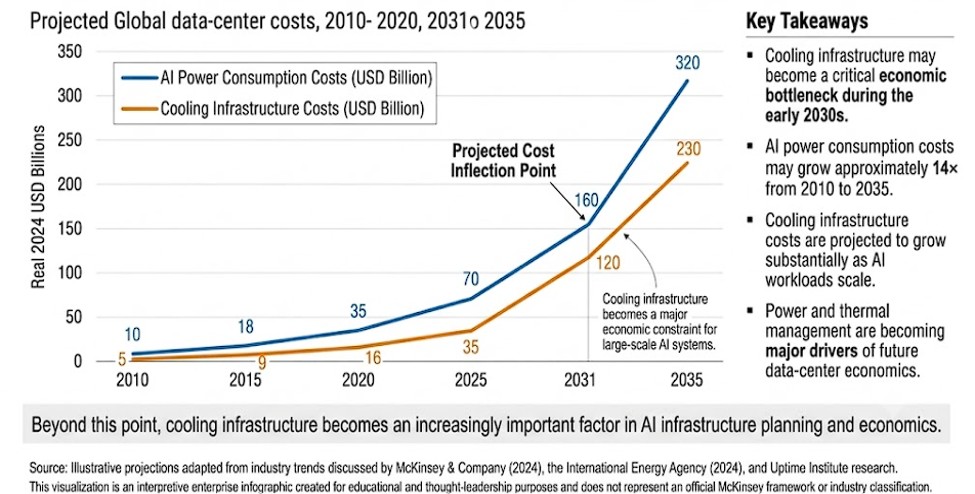
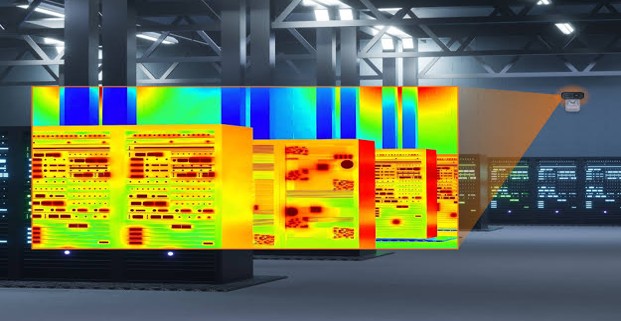
Figure 5: Traditional Data Center
Sustainability and Environmental Impact
The push toward orbit is not simply an engineering challenge; it is deeply intertwined with corporate sustainability goals. Terrestrial hyperscale data centers are currently drawing immense scrutiny for their environmental footprints.
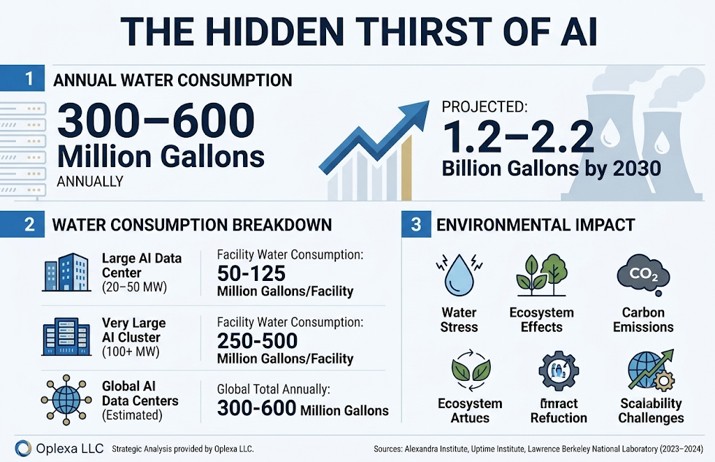
Water consumption is a primary stressor. A modern AI training cluster can consume millions of gallons of potable water annually just for evaporative cooling towers. In regions facing historic droughts, prioritizing water for server farms over agricultural or residential use is becoming a severe socio-political flashpoint.
Figure 6: Water Consumption Visualization
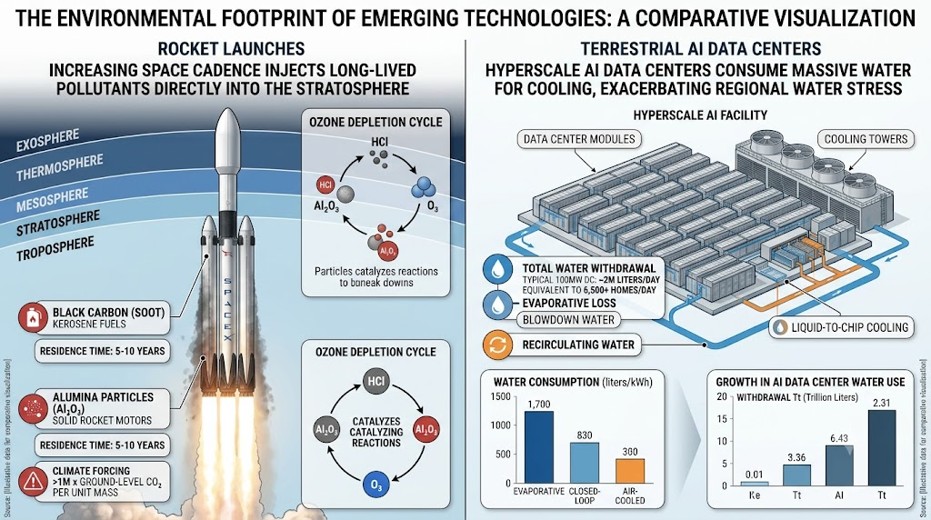
However, the move to space carries its own environmental ledger. The deployment of thousands of orbital servers requires an astronomical cadence of rocket launches. While reusable rocketry has mitigated some financial costs, rocket emissions—including black carbon, alumina, and water vapor deposited directly into the upper stratosphere—present an emerging environmental concern. The future of orbital computing must balance the alleviation of Earth’s surface resources against the atmospheric impact of continuous heavy-lift launches.
Figure 7: Rocket Emissions Impact
The Case for Data Centers in Space
Terrestrial data centers are bound by the laws of geography, politics, and physics. They rely on local utility grids, which may use fossil fuels or suffer from instability. They require massive square footage near fiber-optic hubs and are subject to local data localization laws.
Space offers a complementary architecture for specific classes of workloads. Consider a data center designed to bypass regional power outages, operate without fresh water for cooling, and communicate with terrestrial headquarters via beams of pure light. This is not science fiction; it is the active research and development frontier of the mid-21st century, combining commercial aerospace with ruggedized edge computing
Table 2: Terrestrial vs Orbital Data Centers
| Constraint | Terrestrial Data Center | Proposed Orbital Data Center |
| Power Source | Tethered to regional grids (coal, natural gas, mixed renewables). | Near-continuous access to high-intensity solar energy in carefully selected orbital configurations. |
| Geographic Limits | Subject to land costs, zoning laws, and natural disaster zones. | Vast, unbounded orbital planes in Low Earth Orbit (LEO). |
| Jurisdiction | Bound by national data localization and sovereignty laws. | Operates in international domain (subject to complex Outer Space Treaty). |
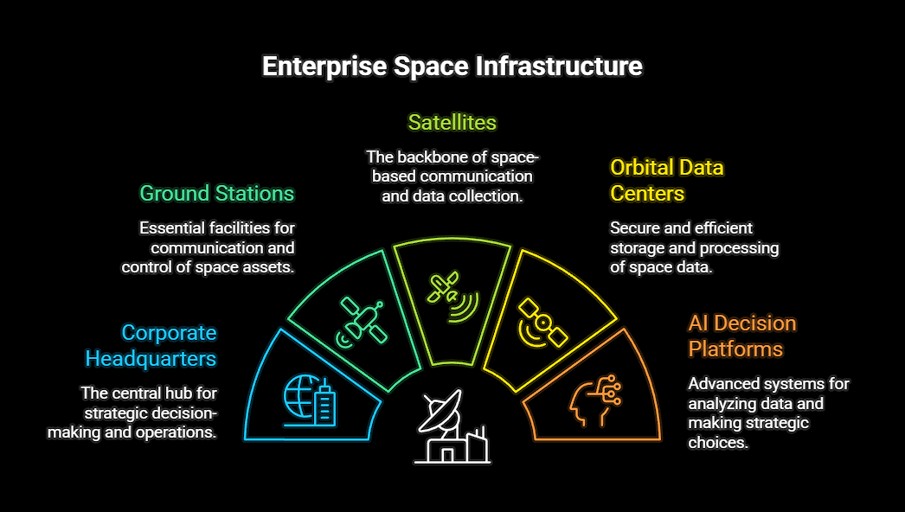
Figure 8: Space Infrastructure Ecosystem Diagram
The History of Computing Beyond Earth
To view orbital AI as an overnight phenomenon ignores a rich history of off-planet computing. The foundational blueprint was drawn during the Apollo era. The Apollo Guidance Computer (AGC) was an engineering marvel that executed complex orbital mechanics with processing power eclipsed by a modern musical greeting card.
As the Space Shuttle and International Space Station (ISS) programs matured, computing in orbit remained highly localized—focused on telemetry, life support, and basic scientific instrumentation. The turning point arrived recently when Hewlett Packard Enterprise (HPE) deployed the Spaceborne Computer to the ISS. By successfully running commercial off-the-shelf (COTS) Linux servers in a zero-gravity, high-radiation environment, HPE proved that enterprise-grade computing could survive without bespoke, billion-dollar spacecraft engineering.
Figure 9: NASA Apollo Guidance Computer
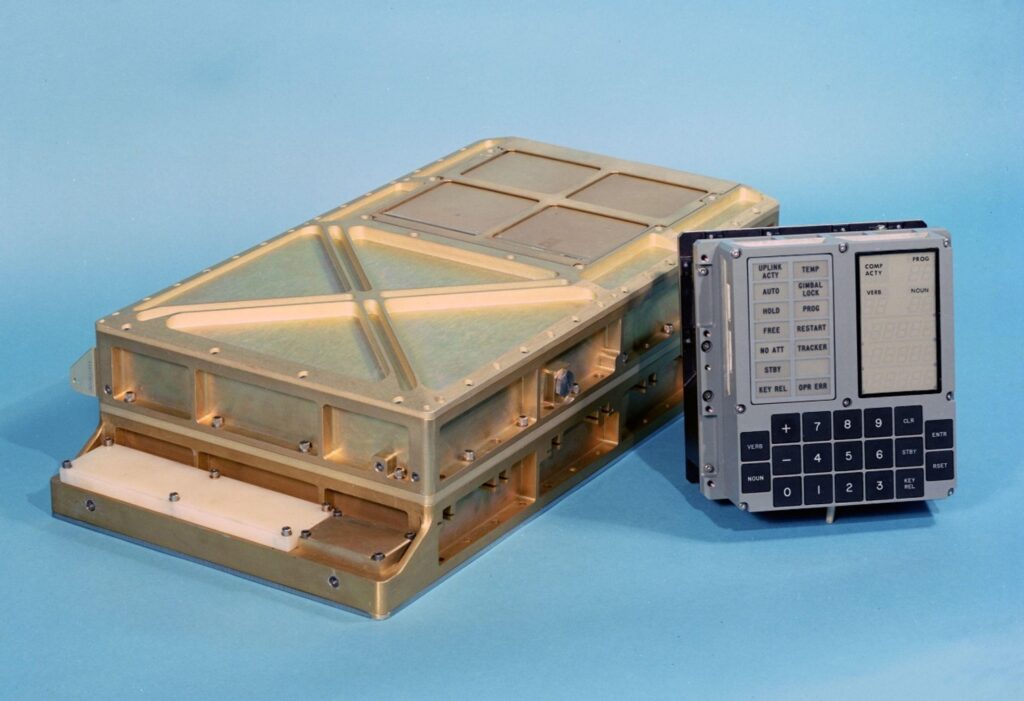
Figure 10: HPE Spaceborne Computer
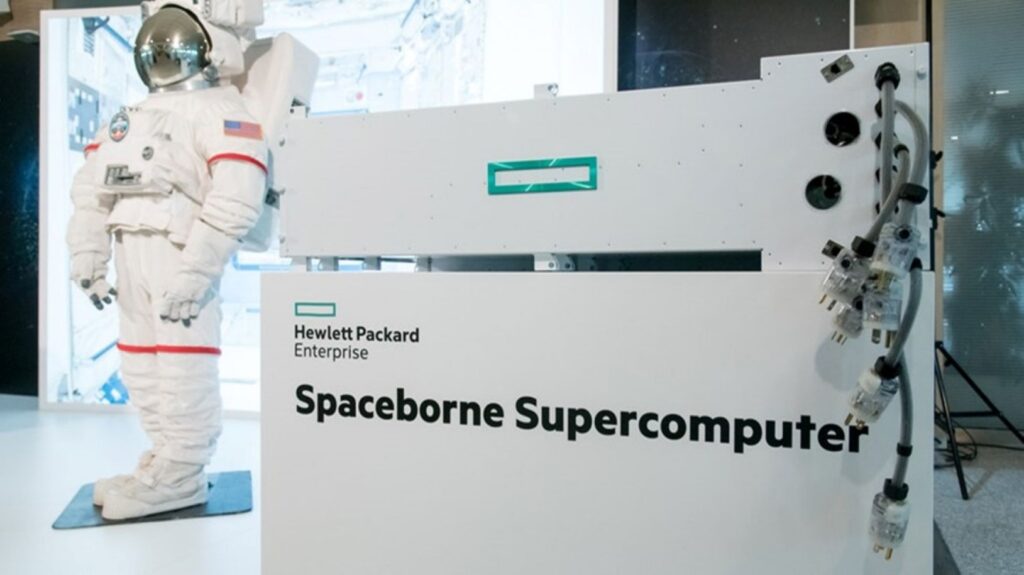
Table 3: History of Space Computing
| Year | Milestone | Significance |
| 1966 | Apollo Guidance Computer | First use of integrated circuits in space navigation. |
| 1981 | Space Shuttle Computers | Redundant computing systems for critical flight control. |
| 2017 | HPE Spaceborne Computer | Demonstrated 1 TeraFLOP of commercial processing on the ISS. |
| 2021 | Edge AI on CubeSats | First autonomous machine learning algorithms executed in orbit. |
How Orbital Computing Could Work
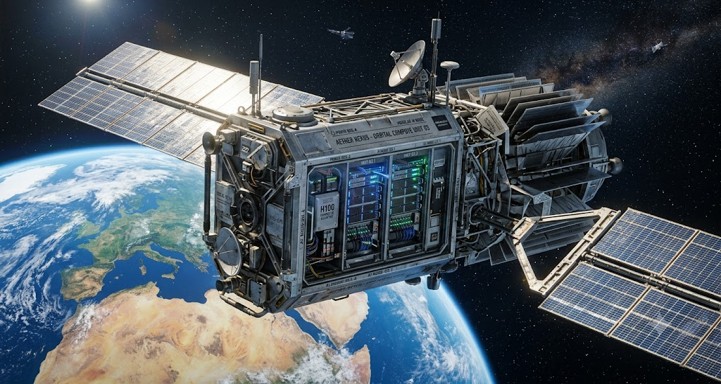
At its core, a space-based data center is exactly what it sounds like: a collection of computer servers launched into orbit. However, rather than sitting inside a concrete building, these servers are housed within specialized satellite chassis designed to survive the harsh environment of space.
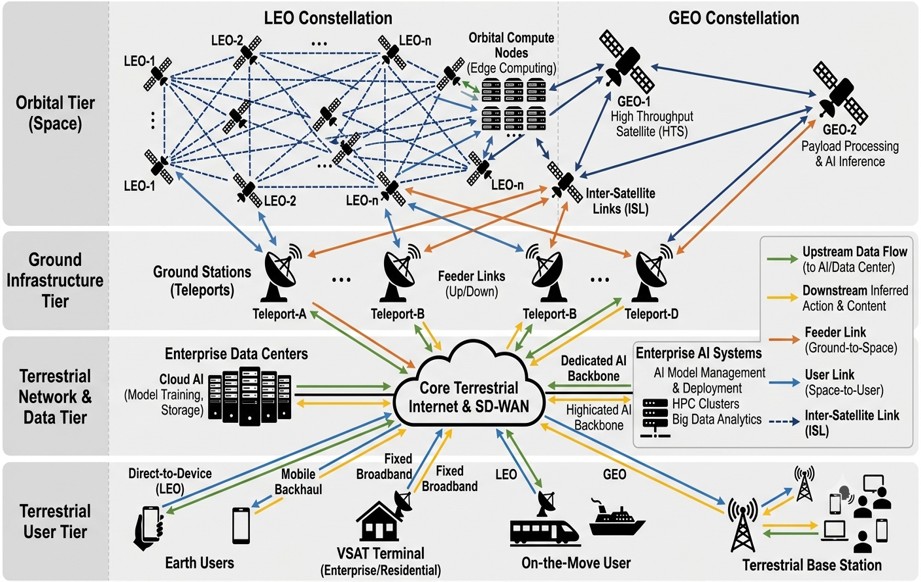
In a standard operational cycle, data originates from either a terrestrial user or an adjacent observation satellite. The data is beamed up via laser or RF link to the orbital node. The processing unit executes the required AI algorithms, sheds heat via radiators, and beams the processed insight back to the enterprise user on Earth.
The Shift to Active Satellites
Historically, satellites have been passive relays. They capture a photo and beam the raw data down to Earth for processing. A space data center flips this model. It processes the raw data in space, turns it into actionable intelligence, and transmits only the finished result down to the user—potentially reducing bandwidth requirements significantly compared to traditional downlinks.
Figure 11: Orbital Server Node
Infographic 2: Orbital Data Processing Pipeline
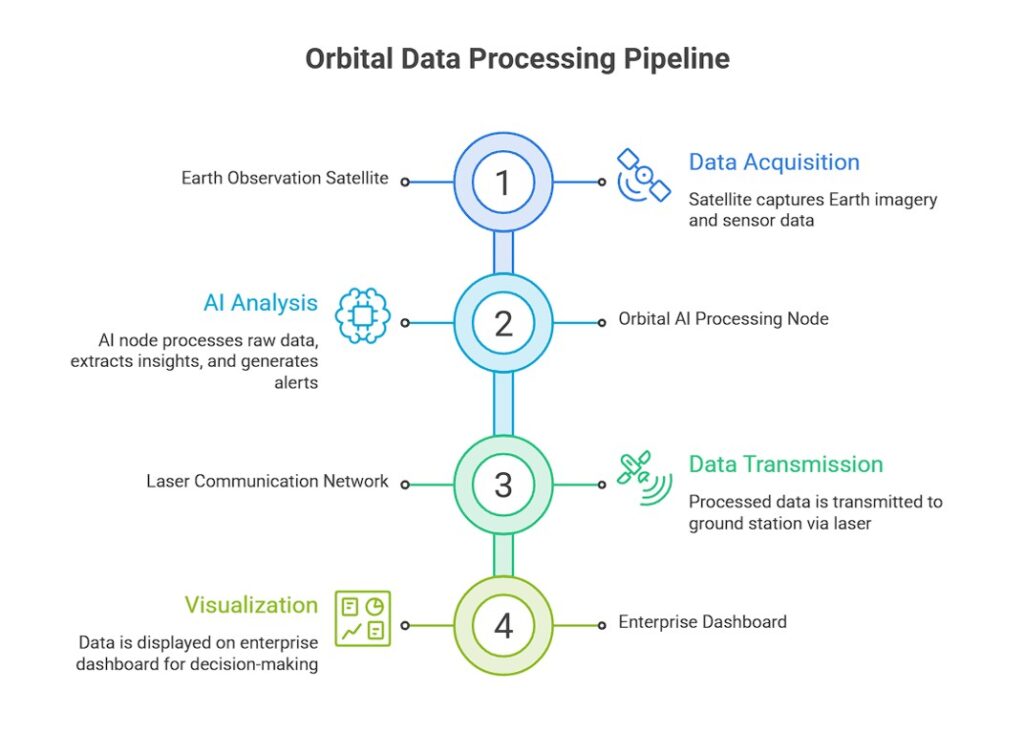
A step-by-step visual from raw data acquisition via Earth observation satellites, local AI inference within the orbital compute node, and the subsequent laser downlink of pure intelligence to Earth.
Powering AI with Solar Energy in Orbit
One of the most compelling arguments for space-based data centers is energy access. On Earth, solar panels are limited by weather, the day/night cycle, and atmospheric interference. In space, the light is unfiltered.
Satellites placed in Sun-synchronous orbits, particularly those operating at high beta angles, can achieve extensive access to high-intensity solar energy. In space, solar irradiance measures roughly 1,361 W/m², unattenuated by atmospheric absorption. However, maintaining continuous operations is complex; even these orbits experience seasonal eclipse periods. Space data centers must therefore incorporate advanced, high-density battery and energy-storage systems to maintain uninterrupted AI operations during orbital nights. This could allow future space data centers to rely on highly consistent renewable energy sources, achieving utilization levels that remain challenging to replicate in many terrestrial environments.
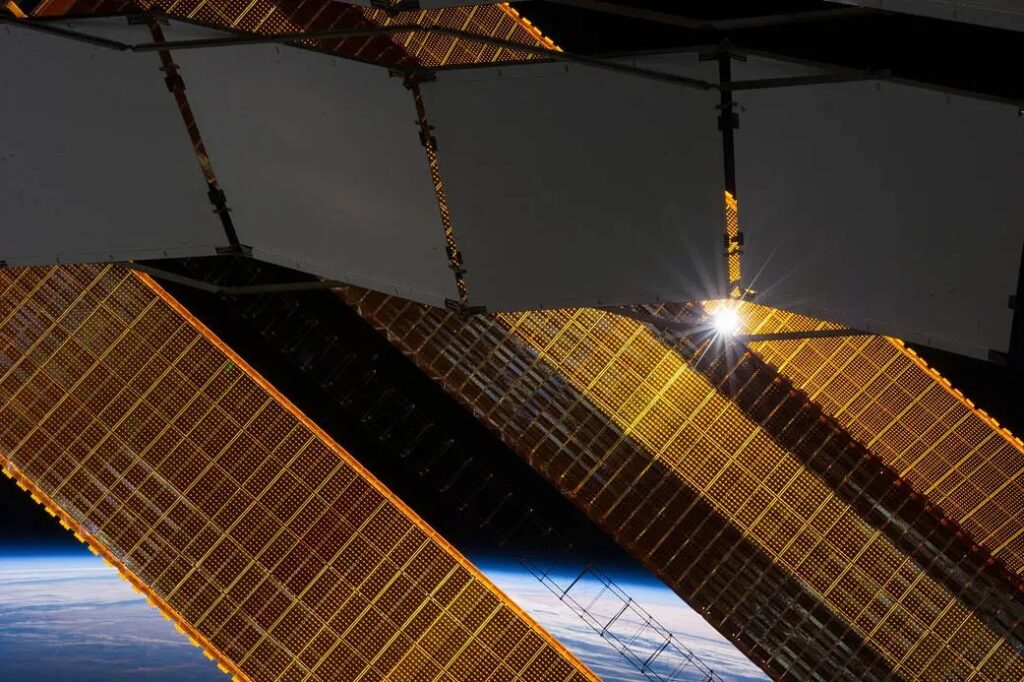
Figure 12: Solar Arrays in Orbit
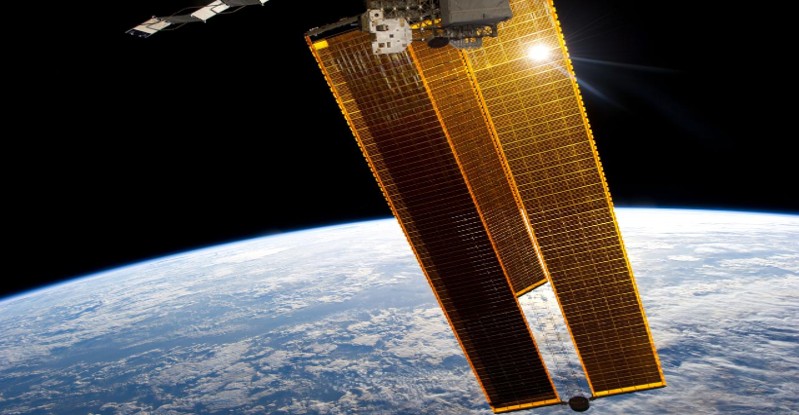
Figure 13: Orbital Data Flow Architecture
The Truth About Cooling in Space
A common misconception must be addressed: space does not make cooling easier. Because space is a vacuum, it acts as an excellent thermal insulator. Convection (which cools terrestrial servers via airflow or water) does not exist in a vacuum.
Instead, heat must be managed entirely through specialized conduction and radiation techniques. Space data centers use a dual-sided design. One side faces the sun to collect power; the other remains in perpetual shadow. Heat generated by GPUs is pumped via conductive heat pipes to large radiator panels on the shadowed side. The heat is then emitted as infrared radiation into the void of space. Orbital cooling may reduce water requirements, but this comes with substantial radiator-area, mass, and thermal-engineering challenges. For perspective, radiating a single megawatt of waste heat in space currently requires thousands of square meters of specialized radiator surface area, imposing severe mass and design penalties.
Table 4: Cooling Methods Comparison
| Cooling Method | Environment | Mechanism | Resource Cost |
| HVAC / CRAC | Terrestrial | Air Convection | High Electricity |
| Evaporative Towers | Terrestrial | Water Phase Change | High Water Usage |
| Immersion Cooling | Terrestrial | Liquid Conduction | High CAPEX (Dielectric Fluids) |
| Cryogenic Radiators | Orbital | Infrared Radiation | Zero Water / Complex Engineering |
Infographic 3: Space Thermal Management
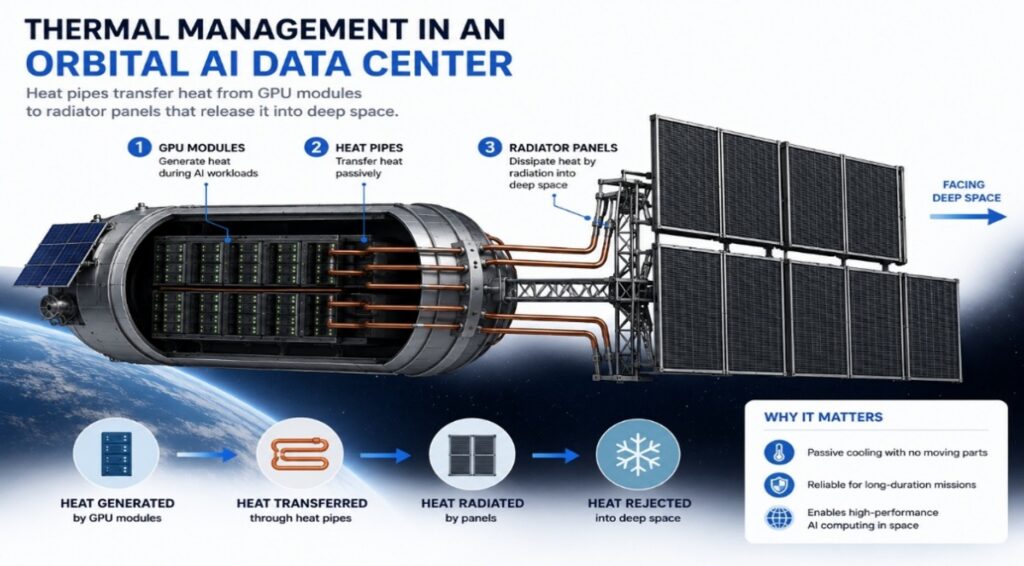
A detailed diagram showing heat pipes drawing thermal loads away from AI processors and dispersing them through dark-side radiator panels into the vacuum.
Figure 14: Orbital Thermal Architecture
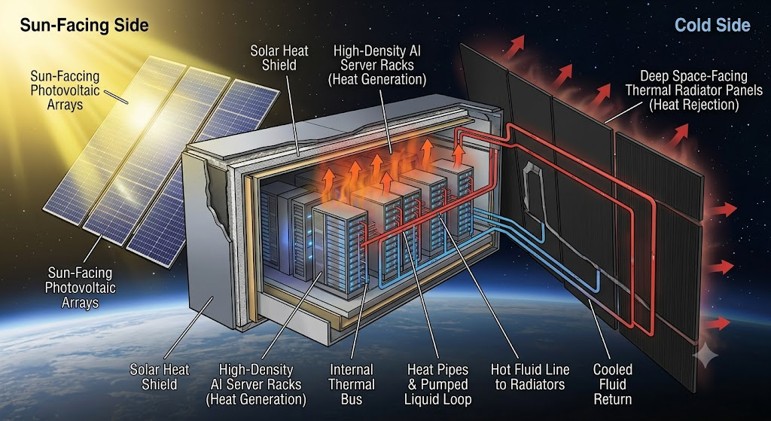
Figure 15: Space Radiator Systems
Laser Networks: The Fiber Optics of Space
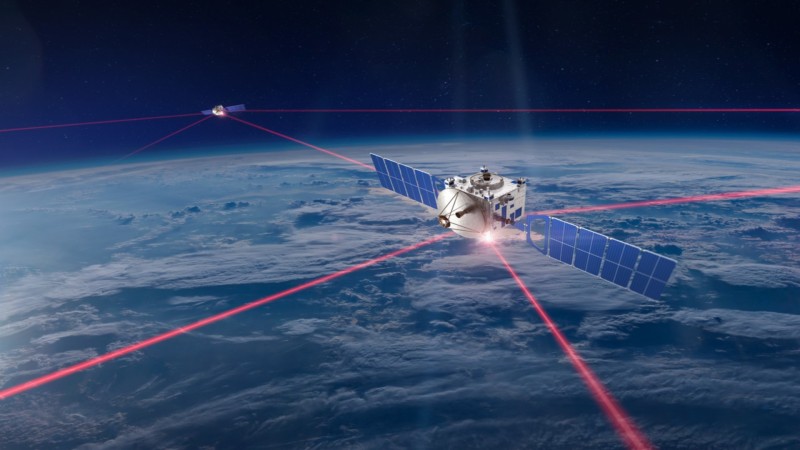
A data center is useless if it cannot communicate. Traditional satellites use radio frequency (RF) bands, which can be slow and congested. The future of space computing relies on Free-Space Optical Communication (FSOC)—better known as laser networking.
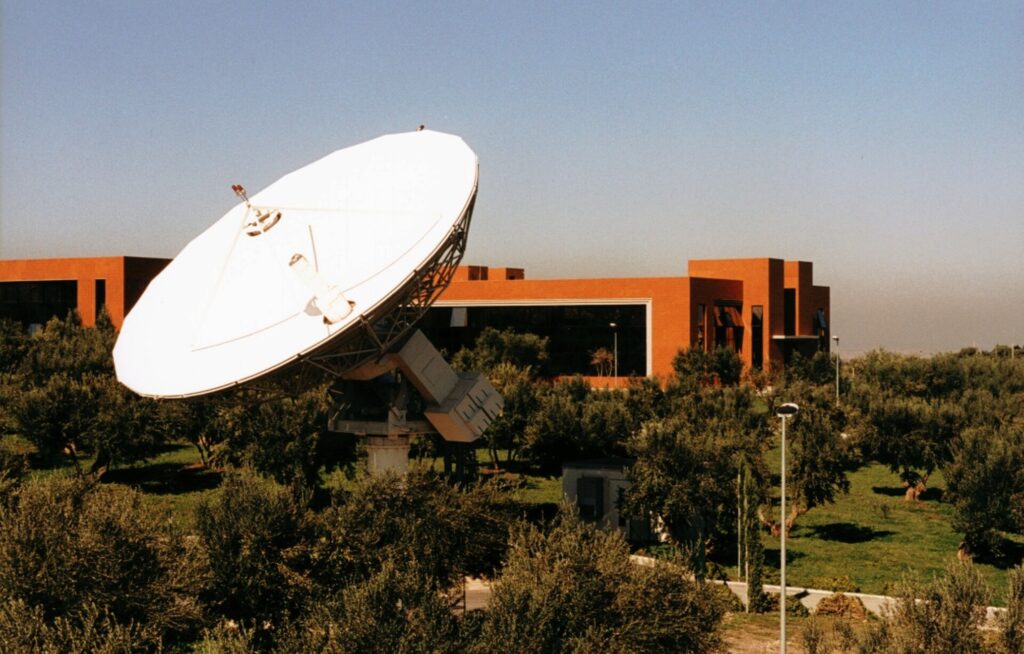
By utilizing free-space optical communication between satellites and Earth ground stations, orbital data centers can achieve exceptional data transfer speeds. Unlike Geostationary Orbit (GEO) satellites which suffer from latency near 600 milliseconds, optical networks in Low Earth Orbit (LEO) can provide round-trip latencies in the 20 to 40 millisecond range. While the narrow beam of a laser reduces broad interception, these systems are not inherently immune to disruption. Optical networks face significant vulnerabilities, including targeted jamming risks, spoofing attacks, ground-station compromise, atmospheric attenuation from weather and clouds, and the physical vulnerability of terrestrial receiving infrastructure.
Figure 16: Laser Communication Networks
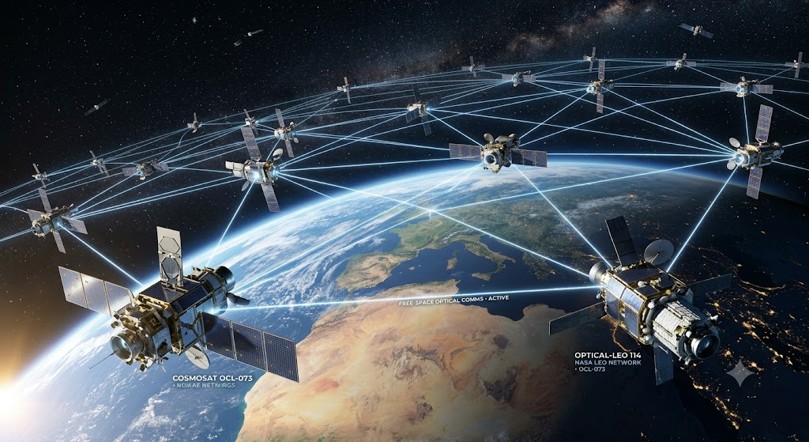
Figure 17: Ground Station Infrastructure
Cybersecurity Beyond Earth
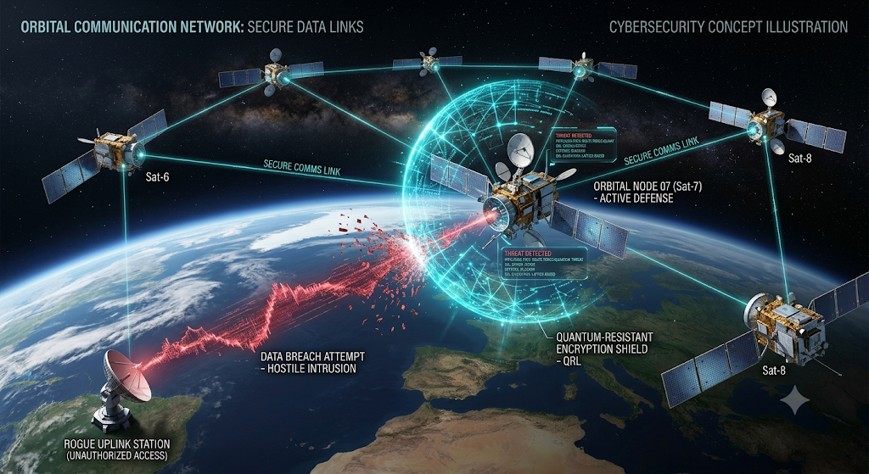
Moving infrastructure to orbit introduces novel cybersecurity challenges. An orbital data center cannot be protected by traditional physical security measures like biometric doors or armed guards. If an orbital node is compromised, technicians cannot “pull the plug.”
Hackers could attempt to hijack the command-and-control links of the satellite, or employ jamming attacks to disrupt data streams. To mitigate these risks, space data centers must employ zero-trust architectures, quantum-resistant cryptography and advanced end-to-end encryption mechanisms, and immutable command ledgers to verify the authenticity of every instruction sent from Earth.
Infographic 4: Orbital Security Architecture
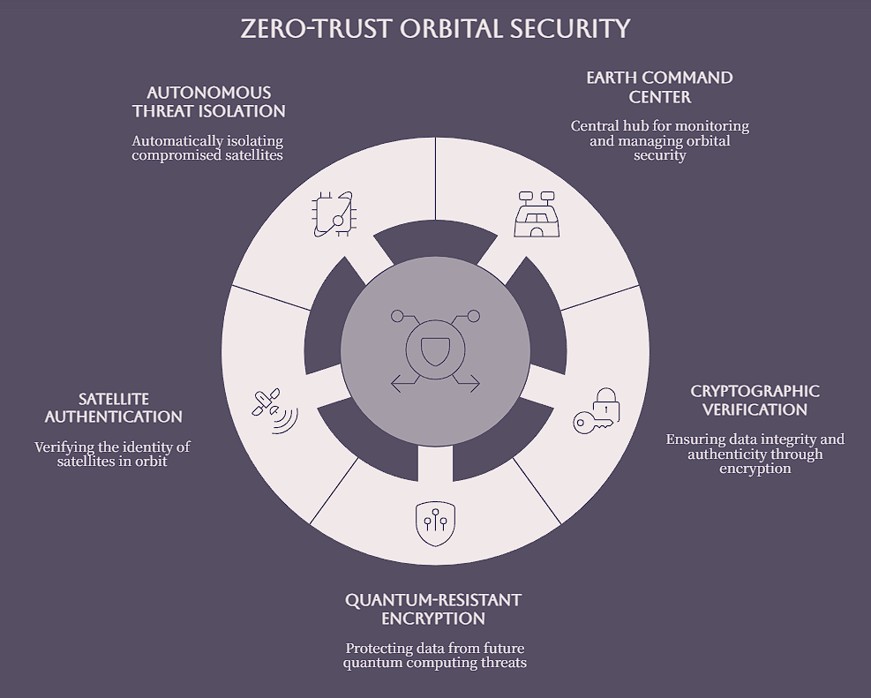
A visual breakdown of Zero-Trust principles applied to space assets, illustrating uplinks secured by quantum-resistant cryptography, hardware roots of trust, and autonomous threat isolation.
Figure 18: Zero-Trust Space Security Diagram
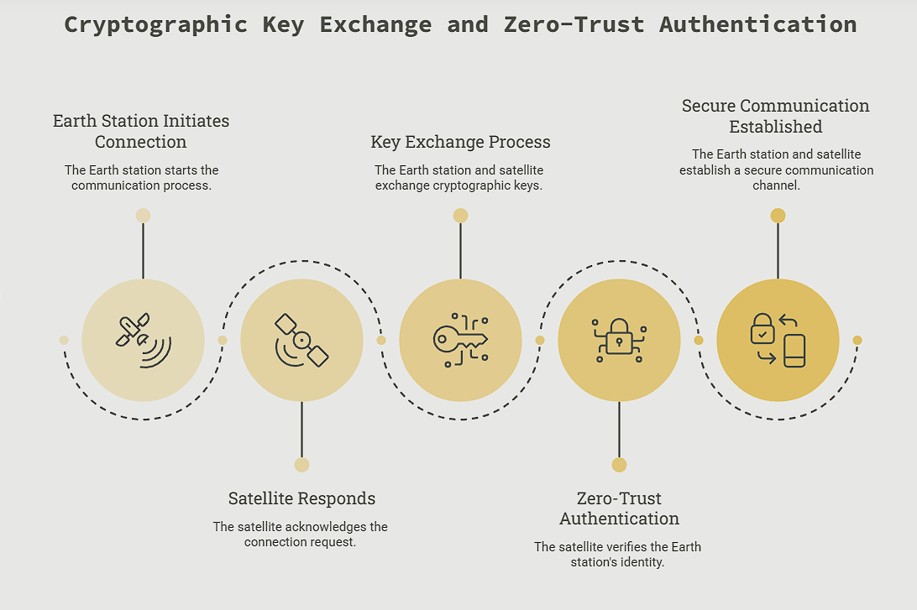
Figure 19: Cyberattack Scenario Illustration
The Space Debris Problem
While space solves Earth’s land and water constraints, it introduces a new environmental challenge: space debris. Low Earth Orbit (LEO) is becoming crowded. Spent rocket stages, dead satellites, and fragments from collisions pose a severe kinetic threat.
The nightmare scenario is the Kessler Syndrome, where a collision creates a cloud of debris that triggers further collisions, rendering certain orbits unusable. To operate sustainably, space data centers must be designed with automated collision avoidance AI and stringent self-deorbiting mechanisms.
Figure 20: Space Debris Visualization
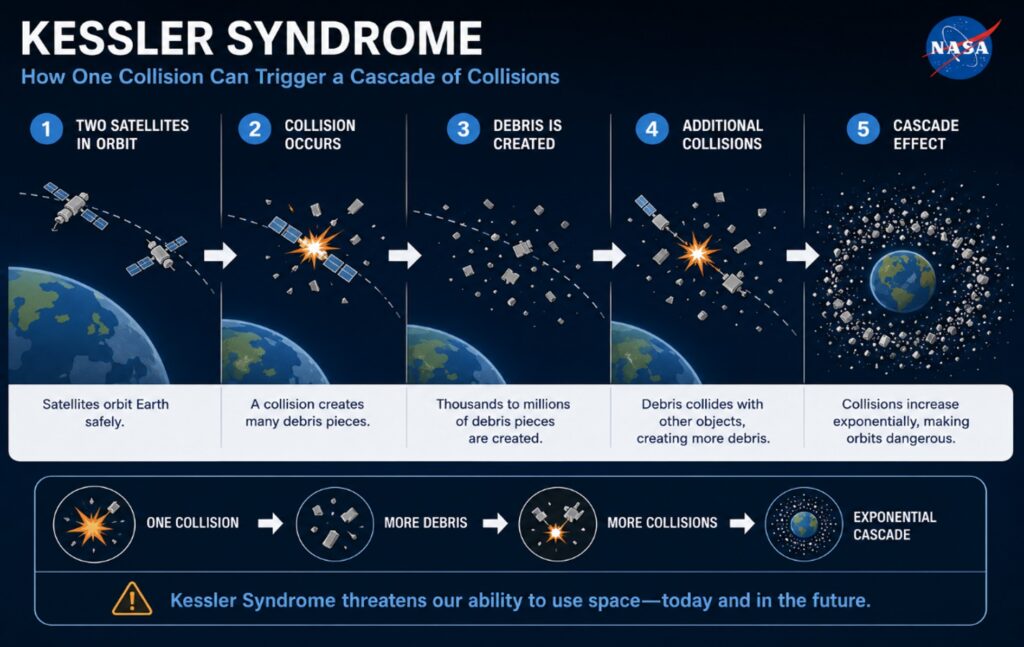
Figure 21: Kessler Syndrome Infographic
Who Is Building the Future of Space Computing?
The space computing race is not solely the domain of traditional aerospace companies. A convergence is occurring between legacy defense contractors, agile startups, and tech titans.
Table 5: Global Space Computing Ecosystem
| Sector / Region | Key Players | Strategic Focus |
| Commercial Tech | AWS, Microsoft Azure, Google | Extending terrestrial cloud services natively into orbital hardware. |
| Aerospace Hardware | SpaceX, Lockheed Martin | Launch logistics, mesh networks (Starlink), and satellite chassis. |
| AI Accelerators | NVIDIA, specialized chip startups | Radiation-hardened edge AI processing and inference hardware. |
| National Agencies | NASA, ESA, ISRO | Deep space exploration, sovereign intelligence, and space sustainability. |
Infographic 5: Global Space Computing Race
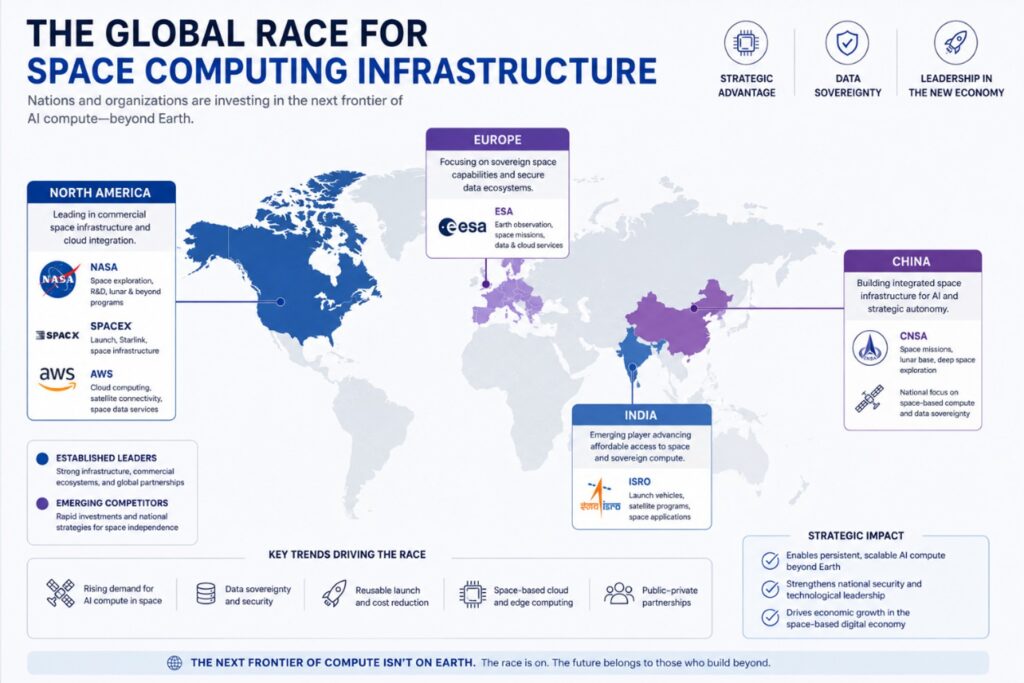
A world map highlighting massive investments in orbital computing infrastructure across North America, Europe, and Asia.
Figure 22: SpaceX Starship Launch
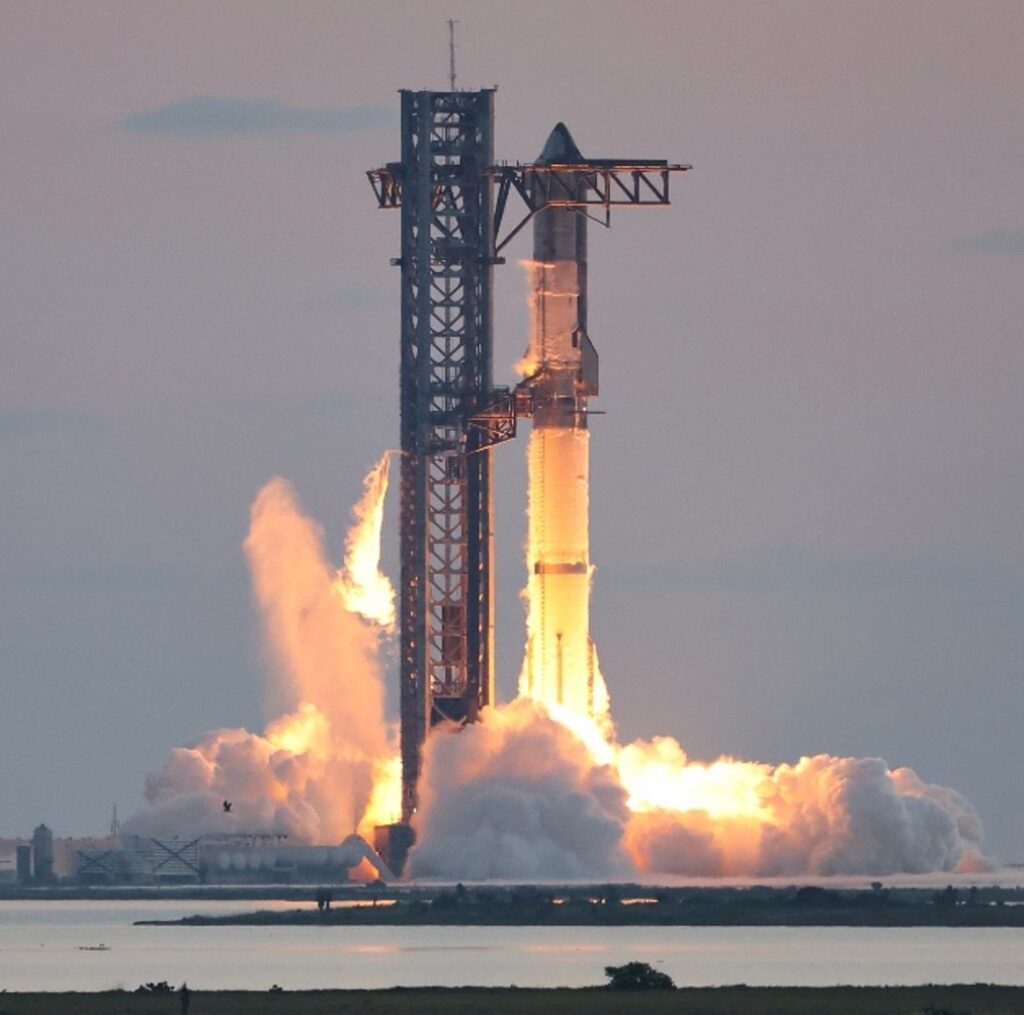
Figure 23: NVIDIA Edge AI Hardware
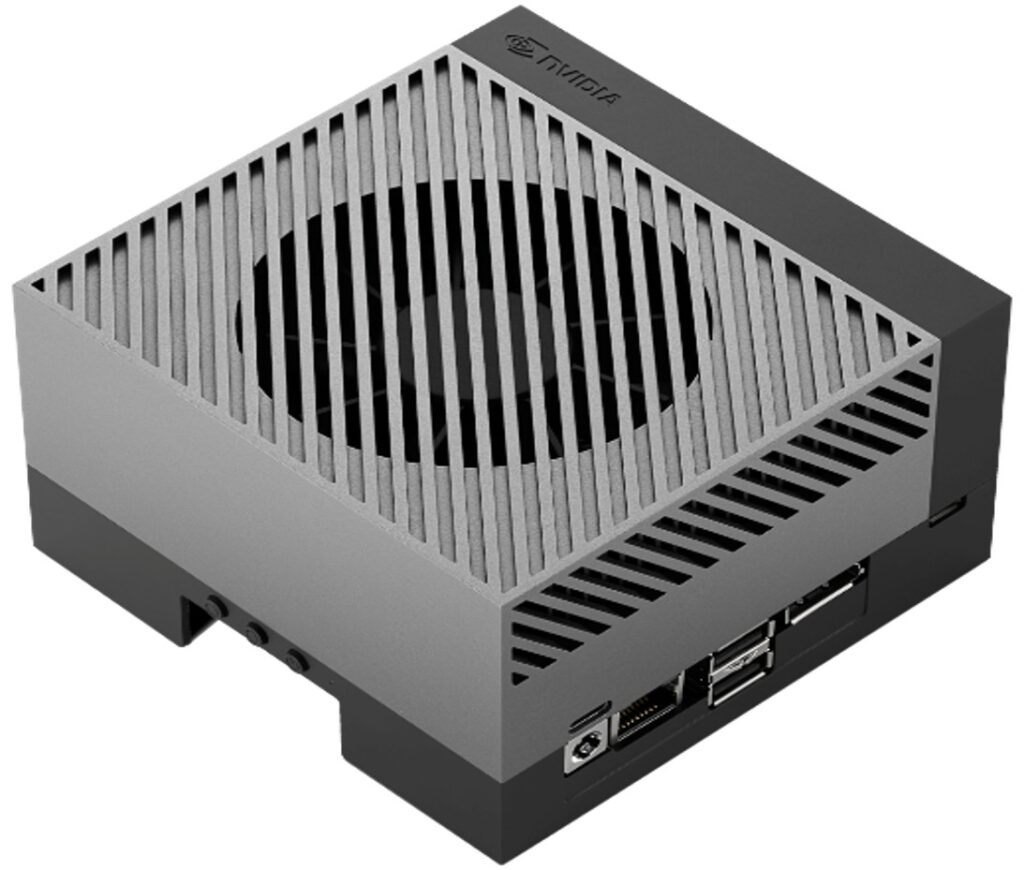
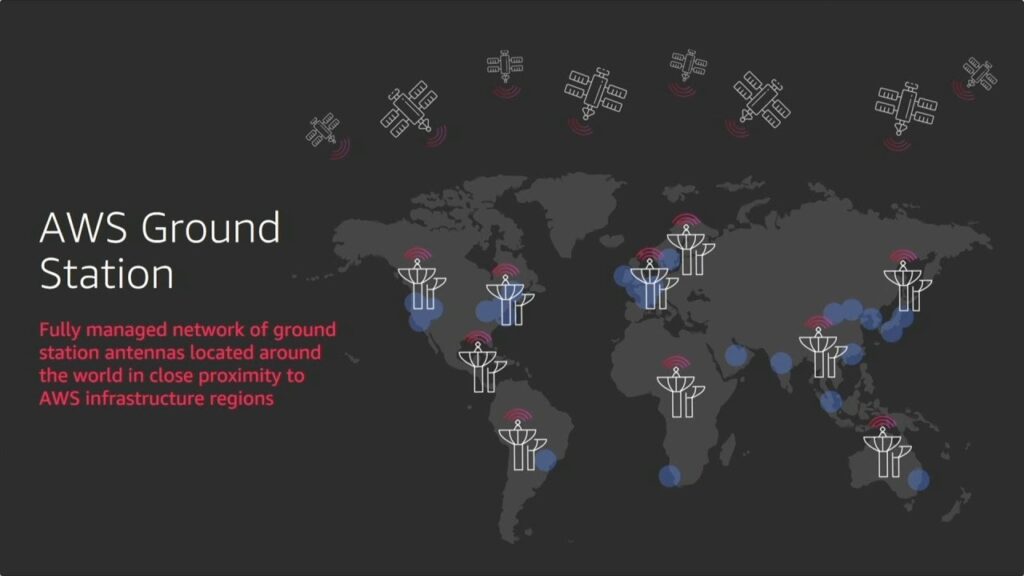
Figure 24: AWS Aerospace Solutions
The Economics of Space-Based Infrastructure
The feasibility of orbital data centers rests heavily on the economics of spaceflight. Historically, the cost to lift a single kilogram into Low Earth Orbit on the Space Shuttle was approximately $54,500 (NASA, 2023). Today, reusable rocketry has catalyzed a dramatic shift in Capital Expenditures (CAPEX), with vehicles like the Falcon 9 dropping current operational launch costs to under $3,000 per kilogram (McKinsey & Company, 2024). Looking ahead, next-generation heavy-lift platforms like SpaceX’s Starship target future costs as low as $100 to $200 per kilogram (McKinsey & Company, 2024).
However, while launch costs are decreasing, the Operating Expenses (OPEX) and insurance considerations for maintaining experimental data centers in a hostile environment remain high. The Return on Investment (ROI) models suggest that parity with terrestrial data centers will only occur when the escalating costs of Earth-based energy and water cooling exceed the combined CAPEX of space deployment and specialized radiation-hardened hardware.
Figure 25: Starlink Mesh Network
Real Enterprise Applications
Orbital AI will likely begin as edge inference for space-native data rather than becoming an immediate replacement for terrestrial hyperscale AI training infrastructure. Why should a Fortune 500 bank or a global logistics firm care about space computing? The answer lies in resilience, global reach, and low-latency data acquisition.
Infographic 6: Enterprise Decision Framework for Orbital Computing Adoption
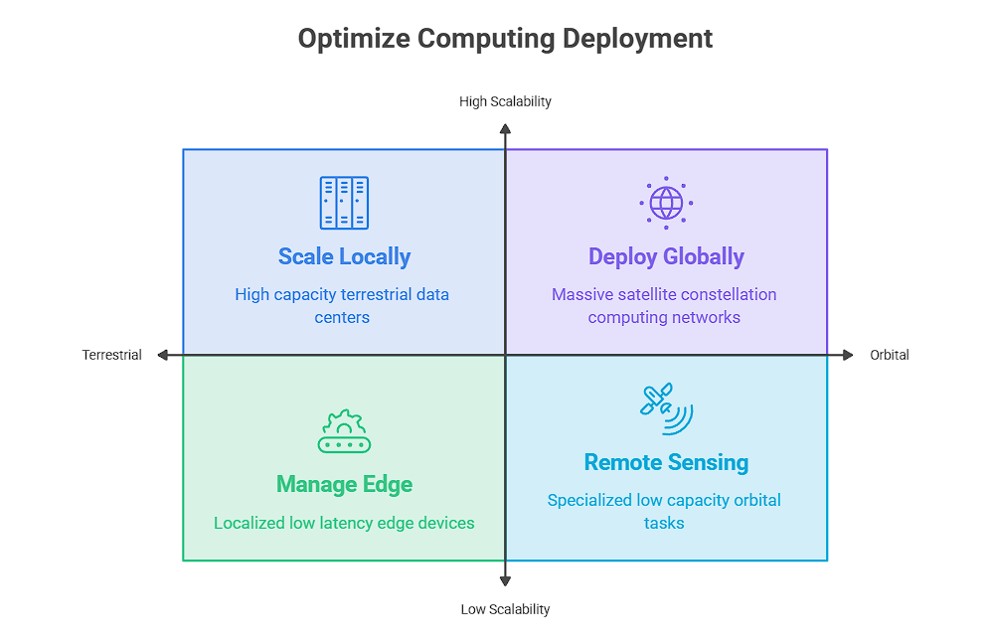
A visual matrix showing which workloads are appropriate for terrestrial environments (heavy archival, legacy DBs), edge environments (local real-time processing), and orbital environments (planetary-scale routing, maritime intelligence).
Table 6: Enterprise Adoption Timeline
| Timeline | Enterprise Adoption Phase | Primary Use Cases |
| Near-Term (By 2028) | Early Adopters & Defense | Secure maritime tracking, classified intelligence processing. |
| Mid-Term (By 2035) | Heavy Enterprise | Global logistics optimization, real-time commodities trading. |
| Long-Term (2040+) | Hybrid Enterprise Platforms | Space-native inference workloads, planetary digital twins, autonomous infrastructure systems, Earth observation intelligence, specialized mission-critical applications. |
Workloads That Fit Orbital AI
Early realistic use cases explicitly position orbital nodes as space-native edge-inference applications. Ideal workloads include:
- Satellite imagery inference: Processing hyperspectral data on-orbit.
- Defense ISR workloads: Real-time intelligence, surveillance, and reconnaissance.
- Maritime and logistics optimization: Routing based on real-time ocean and weather data.
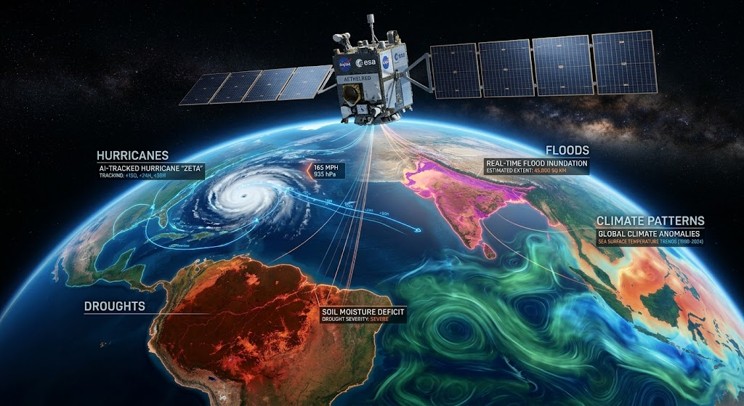
- Climate and environmental monitoring: Instantaneous tracking of natural disasters.
- Autonomous space-mission computing: Managing satellite constellations without ground intervention.
Workloads That Do Not Yet Fit Orbital AI
Current orbital infrastructure is not yet suitable for broad commercial cloud replacement. The engineering and regulatory realities of space mean that the following workloads will remain terrestrial for the foreseeable future:
- Frontier LLM training: The power and cluster requirements far exceed near-term orbital payload limits.
- Hyperscale AI model development: Iterative development requiring massive, rapid read/write cycles.
- Ultra-low-latency consumer applications: Edge computing on Earth remains faster for local devices.
- Conventional enterprise workloads: Traditional databases and applications lack the necessary cost-to-benefit ratio for space deployment.
- Highly regulated data: Information requiring strict, physical sovereign jurisdiction guarantees.
Figure 26: Enterprise Logistics Use Cases
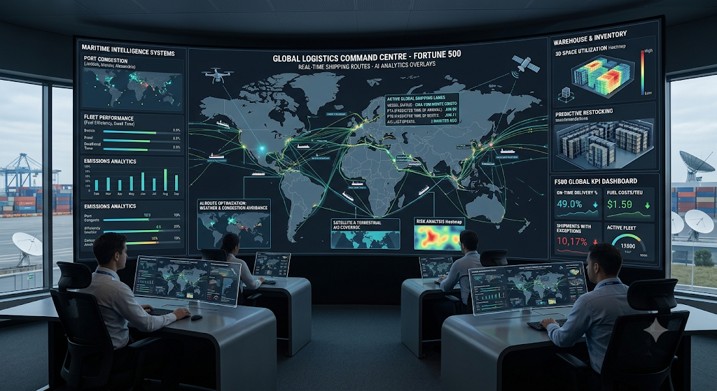
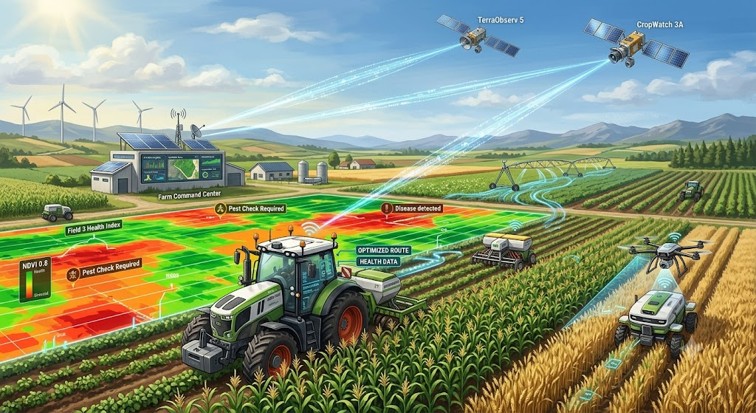
Figure 27: Smart Agriculture Satellites
Challenges That Still Stand in the Way
Despite the immense promise, we must look at this objectively. Monumental hurdles remain.
Economics: As noted, lifting tons of server racks remains expensive. The ROI will only become favorable once terrestrial resources become prohibitively expensive or strictly regulated.
Maintenance: On Earth, a failed GPU is swapped by a technician in minutes. In space, physical repair is currently near-impossible. Future architectures must rely heavily on robotic servicing and extreme redundancy.
Radiation: High-energy cosmic rays can cause “soft errors” and “bit flips,” corrupting AI calculations. Implementing heavy radiation hardening limits the performance of GPUs in space compared to their terrestrial counterparts.
Regulations & Environment: The Outer Space Treaty is ill-equipped to handle modern orbital data sovereignty issues. Who owns the cloud when it crosses international borders every 90 minutes?
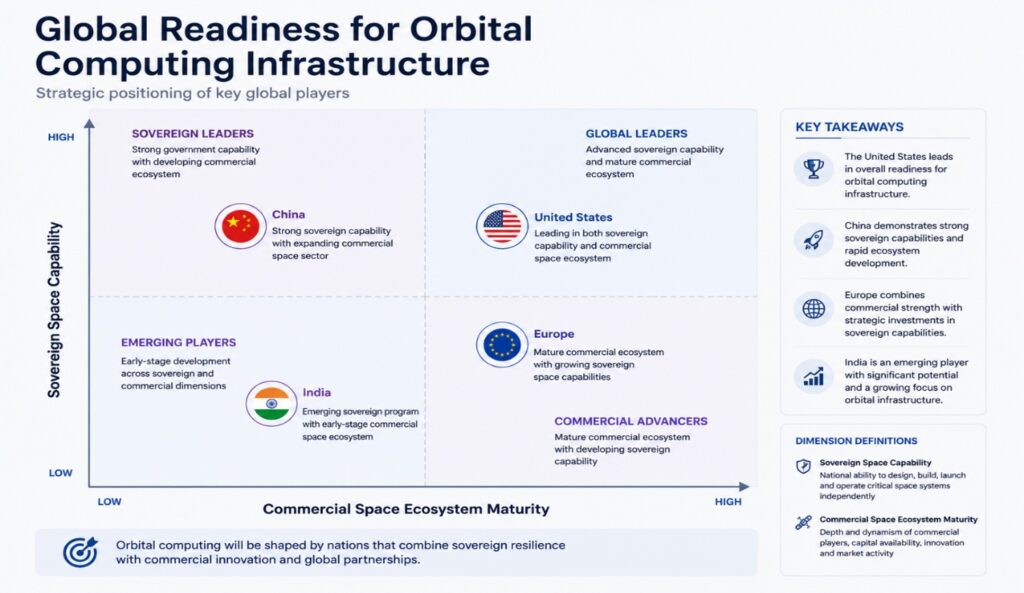
Figure 28: Global Competition Map
Future Research Directions
To overcome these challenges, massive R&D investments are flowing into adjacent technologies that will enable the orbital cloud.
Autonomous maintenance is a critical frontier. Space robotics companies are designing specialized servicing vehicles capable of docking with data satellites to swap out degraded compute blades without human intervention. Simultaneously, researchers are exploring quantum-resistant cryptography to provide significantly more resilient and future-proof communication links between orbital nodes, and materials science is pushing the boundaries of radiation-shielding polymers to protect delicate AI chips.
Figure 29: Autonomous Robotic Maintenance Systems
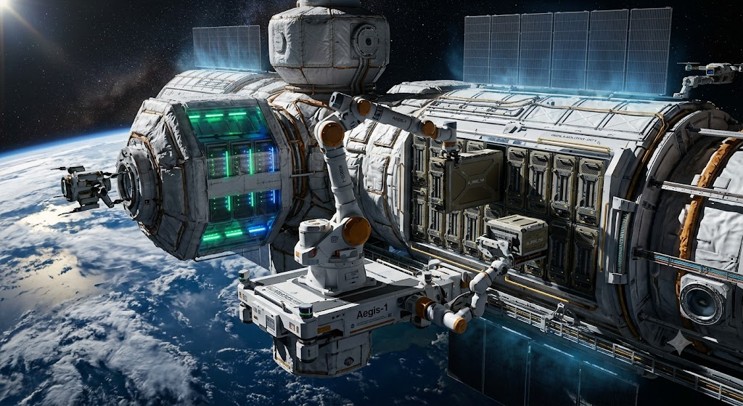
Figure 30: Climate Monitoring Systems
What Could Happen Between 2030 and 2050?
Looking ahead, researchers suggest the evolution of orbital infrastructure may occur in three distinct phases, eventually expanding beyond Earth’s gravity well entirely.
Table 7: Future Computing Evolution (2025–2050)
| Decade | Evolutionary Phase | Architectural Capability |
| 2025–2030 | The Edge Constellations | Small compute nodes filtering Earth observation data. |
| 2030–2040 | The Orbital Cloud | Modular edge-compute platforms supporting Earth observation, logistics, autonomous missions, and specialized enterprise intelligence workloads. |
| 2040–2050 | The Deep Space Grid | Interplanetary networks supporting Moon and Mars settlements. |
As humanity establishes permanent footholds on the Moon and sets its sights on Mars, deep space computing will become a necessity. The light-speed delay to Mars can be up to 24 minutes; cloud computing cannot operate on a 48-minute round trip. Autonomous Martian settlements will require localized, planetary-scale AI data centers.
Infographic 7: Future Planetary Computing Networks
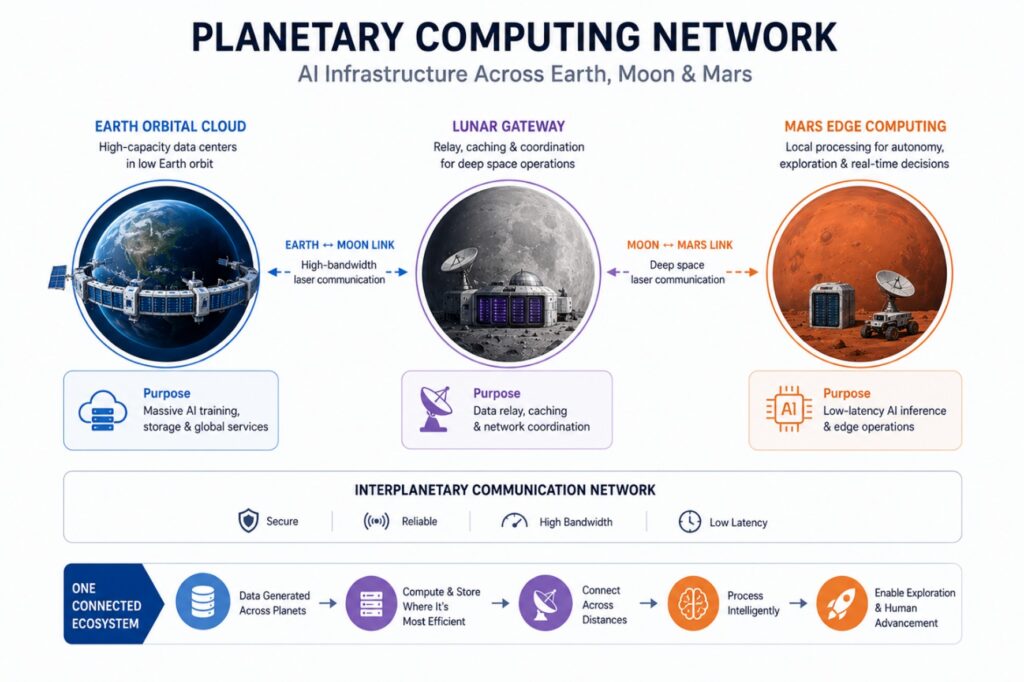
A mapping of how data will flow from Earth’s orbital cloud to Lunar gateway servers, and eventually bridge to Martian edge facilities.
Figure 31: Moon Data Center Concept
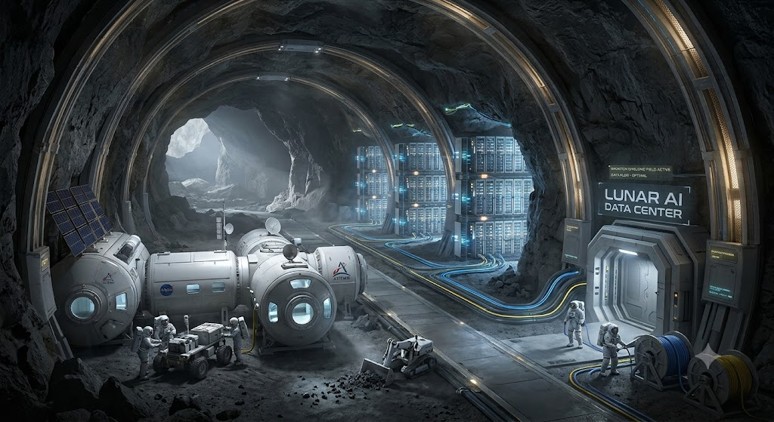
Figure 32: Mars Edge Computing Concept
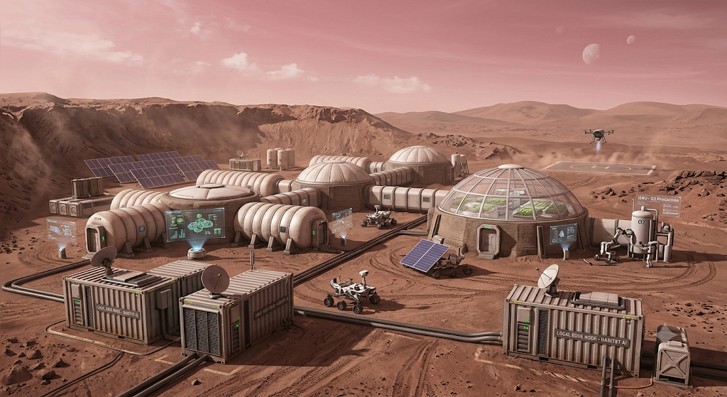
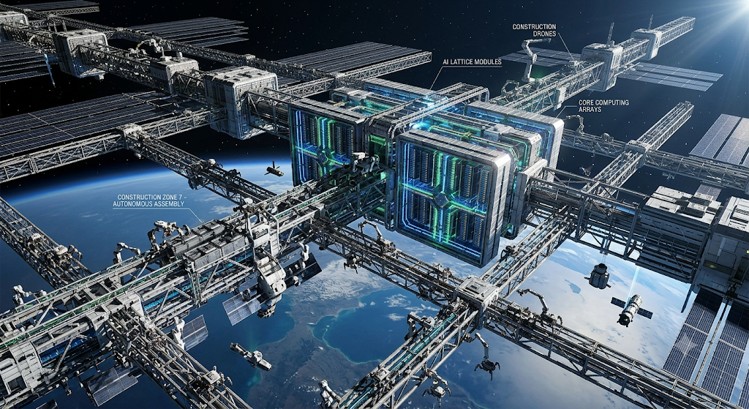
Figure 33: Future Orbital Megastructure Concept
Oplexa’s Perspective
At Oplexa LLC, we continuously study emerging computing paradigms, including orbital edge computing, to help enterprises prepare for future digital transformation opportunities. Our focus is squarely on Decision Intelligence and equipping organizations with architectures capable of adapting to next-generation hardware environments.
As terrestrial limits on power and cooling constrain the scaling of AI, hybrid space-Earth architectures may become a strategic necessity. Oplexa’s view is that the first commercially viable architecture will likely be hybrid: terrestrial AI training, orbital inference, laser-linked edge nodes, zero-trust command planes, and intelligent AI-native workload placement across environments. We believe that forward-looking organizations should begin designing data pipelines today that are resilient, scalable, and agnostic of physical geography.
Infographic 8: Enterprise Hybrid Cloud Models
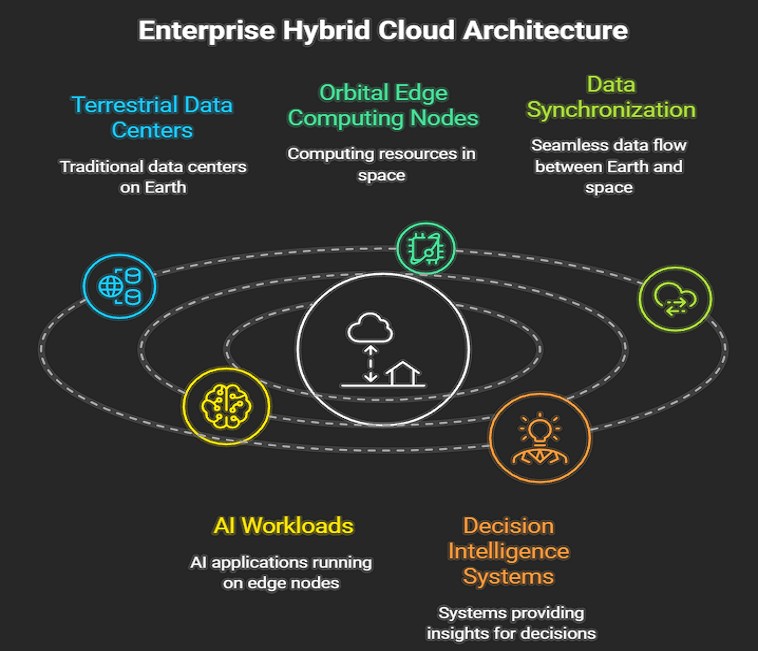
Demonstrating Oplexa’s strategic vision: How terrestrial heavy-batch processing will seamlessly synchronize with agile, low-latency orbital edge nodes.
Figure 34: Enterprise Hybrid Cloud Concept
Final Thoughts
The insatiable demand for AI computational power is pushing our planet’s infrastructure to its limits. Data Centers in the Sky offer an elegant, albeit highly complex, solution: trading the geographic and resource constraints of Earth for access to abundant solar energy and novel radiative thermal management opportunities in space.
The convergence of reusable rocketry, laser communications, and edge AI hardware is moving this concept from science fiction to serious research. For enterprises, understanding this shift is an essential component of future-proofing digital strategy.
As we stand on the precipice of this new computing era, enterprise leaders must ask themselves: Is our data architecture agile enough to seamlessly integrate with the orbital networks of tomorrow? Now is the time to start designing resilient, geography-agnostic pipelines ready for the next frontier.
The next cloud region may not be defined by geography, but by orbital mechanics.
References and Further Reading
Images used in this publication are sourced from a combination of official public-domain resources, corporate media kits, open-license repositories, custom infographics, and AI-generated conceptual artwork created for illustrative purposes.
Amazon Web Services. (2023). Architecting for the Edge in Low Earth Orbit. AWS Whitepapers. https://aws.amazon.com/aerospace-and-satellite/
European Space Agency. (2023). Space-Based Solar Power Preparatory Programme: Solaris. ESA General Publications. https://www.esa.int/Enabling_Support/Space_Engineering_Technology/SOLARIS
Hewlett Packard Enterprise. (2020). Spaceborne Computer-2: Supercomputing on the International Space Station. HPE Technical White Papers.
IEEE Aerospace Conference. (2023). Advances in Space-Based Edge Computing and Orbital Communication Systems. IEEE Xplore Digital Library. https://ieeexplore.ieee.org/
International Energy Agency (IEA). (2024). Electricity 2024: Analysis and Forecast to 2026. IEA Publications. https://www.iea.org/reports/electricity-2024
McKinsey & Company. (2024). The Space Economy: Scaling the New Frontier. Aerospace and Defense Practice. McKinsey Global Institute.
NASA. (2023). State-of-the-Art Small Spacecraft Technology: Thermal Control Systems. NASA Technical Reports Server (NTRS).
NVIDIA Corporation. (2024). Accelerated Computing for Aerospace and High-Radiation Environments. NVIDIA Technical Blogs.
United Nations Office for Outer Space Affairs. (1967). Treaty on Principles Governing the Activities of States in the Exploration and Use of Outer Space, including the Moon and Other Celestial Bodies. UNODA Resolution 2222 (XXI).
Uptime Institute. (2023). Annual Data Center Survey: Water Consumption and Cooling Trends. Uptime Institute Intelligence.
Publication Note: This article is intended as a thought-leadership exploration of emerging AI infrastructure paradigms. It combines current technological developments with forward-looking concepts under active research across industry, academia, and governmental space agencies.