


By Carter James | Oplexa Insights
Mar 2026 | 16 Min Read
GTC 2026 is over. Four days, 30,000 attendees from 190 countries, 1,000 sessions, 2,000 speakers — and one Jensen Huang GTC 2026 Keynote that redefined what NVIDIA is building for the next decade.
This was not a chip launch event. This was NVIDIA’s declaration that the agentic and physical AI era has officially begun. From a $1 trillion infrastructure order backlog to open-source AI agents, humanoid robots, and gigawatt-scale AI factories — GTC 2026 covered every layer of the AI stack in one sweeping two-hour keynote.
For investors, enterprises, and technology leaders, this GTC 2026 wrap-up covers every announcement that matters — and what each one means for AI infrastructure, the semiconductor industry, and your business through 2027 and beyond.
“GPUs are just a small part of what NVIDIA does now. It’s all about the AI.” — Jensen Huang, GTC 2026 closing keynote
GTC 2026 At a Glance — 10 Announcements Summary
| # | Announcement | Why It Matters |
| 1 | $1 Trillion Infrastructure Orders | Biggest revenue signal in NVIDIA history |
| 2 | Vera Rubin NVL72 — Now Shipping | Azure first to deploy — hyperscaler race begins |
| 3 | Groq 3 LPX Rack — 35x Token Efficiency | Inference cost war officially launched |
| 4 | OpenClaw + NemoClaw — Agentic AI Stack | CUDA moat extended into software agents |
| 5 | Physical AI Data Factory Blueprint | Robotics training data bottleneck solved |
| 6 | IGX Thor — Generally Available | Industrial Physical AI now in production |
| 7 | Drive Hyperion — 5 New Automakers | Nissan, BYD, Geely, Isuzu, Hyundai onboard |
| 8 | DLSS 5 — 3D Neural Rendering | Gaming AI reinvented with probabilistic rendering |
| 9 | Intel x NVIDIA — NVLink x86 CPU | CPU-GPU integration at data center scale |
| 10 | Vera Ultra 2027 + Feynman 2028 Preview | 3-generation roadmap gives hyperscalers visibility |
1. $1 Trillion Infrastructure Orders — The Biggest Number in NVIDIA History
Jensen Huang opened the GTC 2026 keynote with the single most significant financial disclosure NVIDIA has ever made in a public setting: purchase orders for Blackwell and Vera Rubin systems combined are expected to reach $1 trillion through 2027. This is double the $500 billion projection NVIDIA had shared just one year earlier at GTC 2025.
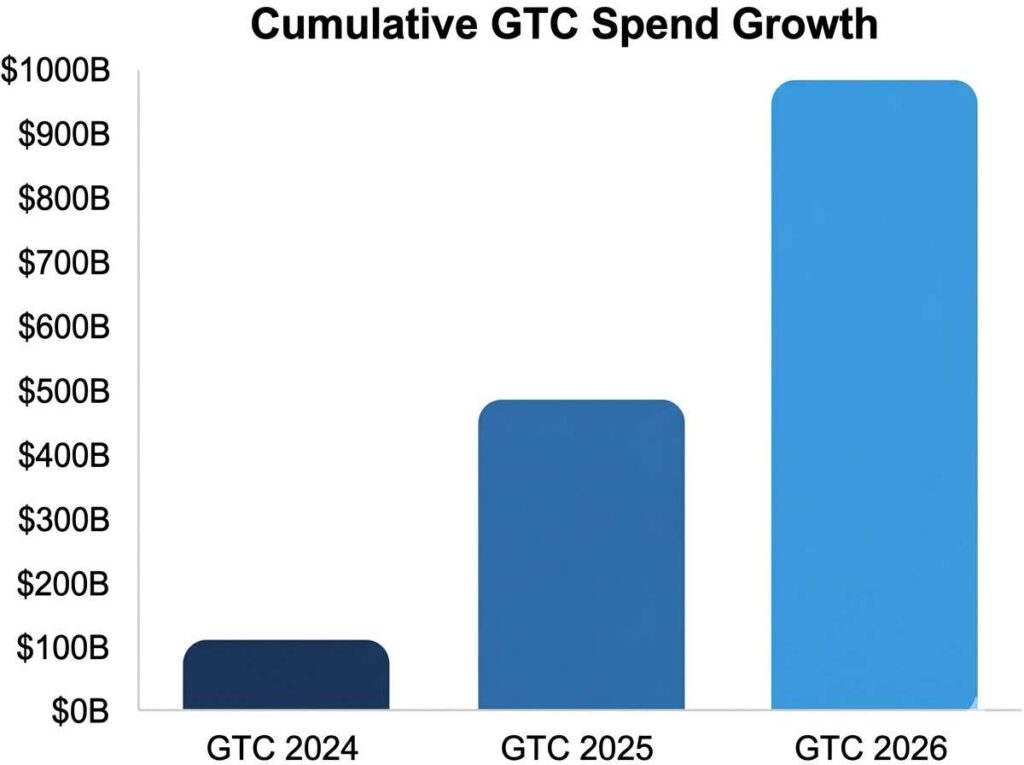
The implication for investors is profound. A $1 trillion order backlog does not mean $1 trillion in near-term revenue — it means committed capital expenditure from hyperscalers, sovereign wealth funds, and enterprises that have locked in NVIDIA as their AI infrastructure provider for the next two to three years. This is the clearest signal yet that NVIDIA’s growth trajectory is not slowing.
📊 Oplexa Report: NVIDIA Strategic Inflection Analysis 2025–2035 — $1T order analysis, Vera Rubin revenue model & 10-year investment thesis →
2. Vera Rubin NVL72 — Shipping Now, Azure First
Microsoft Azure became the first hyperscale cloud provider to power up NVIDIA’s Vera Rubin NVL72 systems — and confirmed a global rollout over the coming months. This is the fastest hyperscaler adoption of any new NVIDIA platform in the company’s history, with hundreds of thousands of liquid-cooled Grace Blackwell GPUs already deployed across Microsoft’s global data centers in under a year.
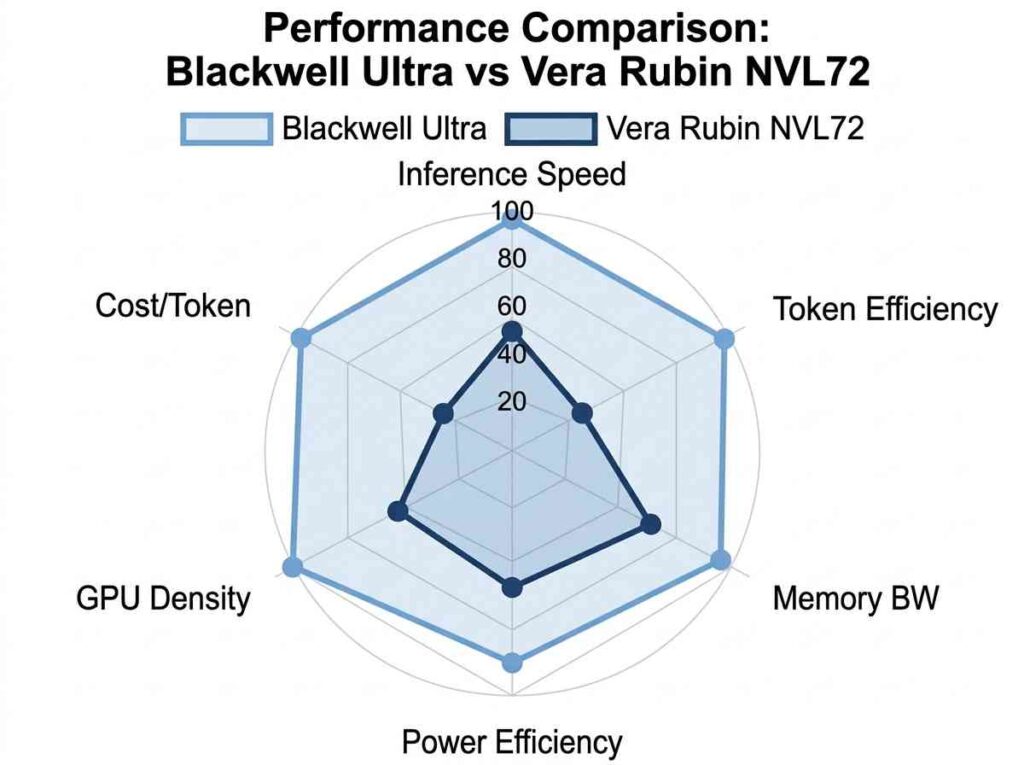
The Vera Rubin platform delivers 5x inference performance improvement over Blackwell Ultra with a 10x reduction in inference token costs. For enterprises running large language models, multimodal AI, or agentic workloads, this cost reduction is not incremental — it is transformational. AI applications that were previously uneconomical at scale are now viable with the Vera Rubin infrastructure.
📊 Oplexa Report: AI Datacenter Networking Revolution — $200B Opportunity: Vera Rubin deployment, liquid cooling & AI factory infrastructure →
3. Groq 3 LPX Rack — 35x Token Efficiency With Vera Rubin
One of the most technically significant announcements at GTC 2026 was the Groq 3 LPX rack — a 256-LPU inference accelerator system designed to sit beside the Vera Rubin NVL72 rack. When combined, the Groq LPX rack increases tokens-per-watt performance of Vera Rubin GPUs by 35x — making this the most power-efficient AI inference system ever announced.
This is a direct assault on the economics of AI inference. As AI shifts from the training era to the inference era — where models are queried billions of times daily — the cost per token becomes the primary competitive variable. NVIDIA’s Groq partnership positions it to dominate inference economics alongside compute performance, eliminating the primary use case for competing inference-only chips from startups like Cerebras and existing Inferentia from Amazon.
📊 Oplexa Report: AI Chip Market Analysis & Forecast 2025–2035 — Groq 3, inference chip competition & custom AI accelerator market →
4. OpenClaw + NemoClaw — NVIDIA’s Agentic AI Operating System
The most strategically consequential software announcement at GTC 2026 was the formal launch of OpenClaw and NemoClaw — NVIDIA’s complete agentic AI stack. OpenClaw is now the most widely adopted open-source operating system for agentic computing — described by Jensen Huang as “Android for agents.” NemoClaw is the production-grade application layer built on top of OpenClaw, enabling enterprises to deploy 24/7 digital workers in days rather than months.
The GTC 2026 Build-a-Claw workshops allowed attendees to deploy production-ready AI agents in under one hour. This developer experience is NVIDIA’s most powerful competitive weapon — by making agentic AI accessible on NVIDIA hardware through open-source tools, it creates the same lock-in dynamic that CUDA established in GPU computing 20 years ago.
Companies partnering with NVIDIA on the Nemotron 4 coalition include LangChain, Perplexity, Mistral AI, and Thinking Machines — signals that the open frontier model ecosystem is consolidating around NVIDIA’s software platform.
5. Physical AI Data Factory Blueprint — The Robotics Training Data Solution
NVIDIA open-sourced its Physical AI Data Factory Blueprint at GTC 2026 — a complete reference architecture using Cosmos open-world foundation models to generate, multiply, score, and curate synthetic training data for robots and autonomous vehicles. This solves what has been the single biggest bottleneck in Physical AI deployment: the lack of high-quality training data at scale.
Cloud partners include Microsoft Azure and Nebius. Isaac GR00T N1.7 is now commercially available with early access to GR00T N2 — setting new benchmarks in humanoid robotics. Cosmos 3 unifies world generation, vision reasoning, and action simulation in a single model — enabling robots to learn physical world interactions through synthetic environments rather than expensive real-world trials.
🆕 NEW Oplexa Report: Physical AI Market 2026: Investment & Forecast Report — IGX Thor, Isaac GR00T, humanoid robots & $83.6B market forecast 2026–2035 →
6. NVIDIA IGX Thor — Physical AI at the Industrial Edge
NVIDIA IGX Thor — its industrial-grade Physical AI platform — became generally available at GTC 2026. IGX Thor delivers real-time Physical AI at the edge with high-speed sensor processing, enterprise-grade reliability, and functional safety certification — enabling autonomous, safety-critical machines in complex industrial environments.
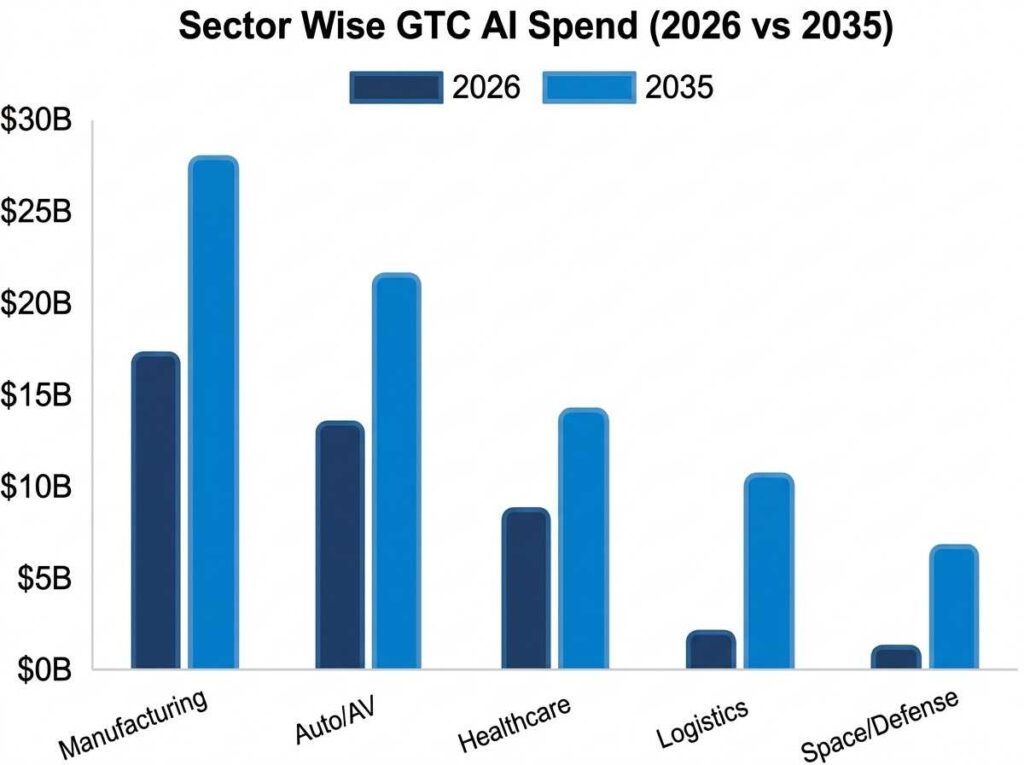
Current deployments span construction, manufacturing, logistics, healthcare, life sciences, and space exploration. Key enterprise customers already live include ABB, KUKA, Caterpillar, KION in manufacturing; Johnson & Johnson, Medtronic, and KARL STORZ in healthcare surgical robotics; and Isuzu and China’s Tier IV, deploying autonomous buses using the AGX Thor platform.
For investors, IGX Thor represents NVIDIA’s first major recurring revenue stream outside data centers — industrial customers pay for hardware, software licenses, and ongoing support contracts in a model that resembles enterprise SaaS more than discrete chip sales.
7. Drive Hyperion — Five New Automakers, Uber in 28 Cities
NVIDIA’s autonomous vehicle platform gained five major new partners at GTC 2026: Nissan, BYD, Geely, Isuzu, and Hyundai — all building Level 4 autonomous vehicles on NVIDIA’s Drive Hyperion program. Isuzu and China’s Tier IV are also deploying autonomous buses using AGX Thor.
The most commercially significant announcement was NVIDIA’s expanded partnership with Uber — the ride-hail giant will launch a robo-taxi fleet powered by NVIDIA Drive AV software across 28 cities in four continents by 2028, starting with Los Angeles and San Francisco in 2027. This represents the largest confirmed commercial deployment of NVIDIA’s autonomous vehicle technology to date.
For the Physical AI market, the automotive vertical is the highest-volume opportunity. A single autonomous vehicle contains dozens of NVIDIA chips for sensing, inference, and safety — and a global robo-taxi fleet of millions of vehicles represents recurring chip demand at a scale that rivals the data center market.
8. DLSS 5 & 3D Neural Rendering — The Gaming AI Revolution
NVIDIA announced DLSS 5 at GTC 2026 — introducing probabilistic rendering and 3D-guided neural rendering as the new standard for gaming graphics. Jensen Huang called the structured data behind rendering “the ground truth of enterprise computing” — a framing that connects gaming AI directly to NVIDIA’s broader enterprise data strategy.
DLSS 5’s probabilistic rendering approach generates frames that were never rendered — effectively allowing games to run at resolutions and frame rates that the underlying hardware could not achieve through traditional rasterization. Combined with IBM WatsonX integration via cuDF and Dell’s AI Data Platform partnership, NVIDIA is positioning its gaming technology as a foundation for enterprise AI data infrastructure.
9. Intel x NVIDIA NVLink — The CPU-GPU Integration Deal
GTC 2026 formally showcased the Intel NVIDIA partnership — NVIDIA’s $5 billion Intel investment paired with a technical collaboration to build custom x86 CPUs integrated via NVLink Fusion. Microsoft Azure confirmed it is already testing the NVLink-integrated Intel x86 CPU configurations in its AI data centers, providing the first production validation of the CPU-GPU integration strategy.
For the semiconductor industry, this is the most significant CPU-GPU integration announcement since AMD launched its unified memory CDNA architecture. NVLink-integrated Intel x86 CPUs create a new class of AI rack architecture — one where CPU orchestration and GPU compute share memory bandwidth at speeds that PCIe cannot approach.
NVIDIA Intel $5B Deal: Why the AI Chip War Just Changed Forever →
10. Vera Ultra (H2 2027) + Feynman (2028) — Three-Generation Roadmap
In an unprecedented move for NVIDIA, Jensen Huang previewed two successor architectures at GTC 2026 — giving hyperscalers and investors three-generation visibility into the GPU roadmap. Vera Ultra arrives in H2 2027 as a mid-cycle refresh of Vera Rubin with backward NVLink compatibility. Feynman follows in 2028 on TSMC’s 1.6nm A16 node with silicon photonics for inter-chip communication.
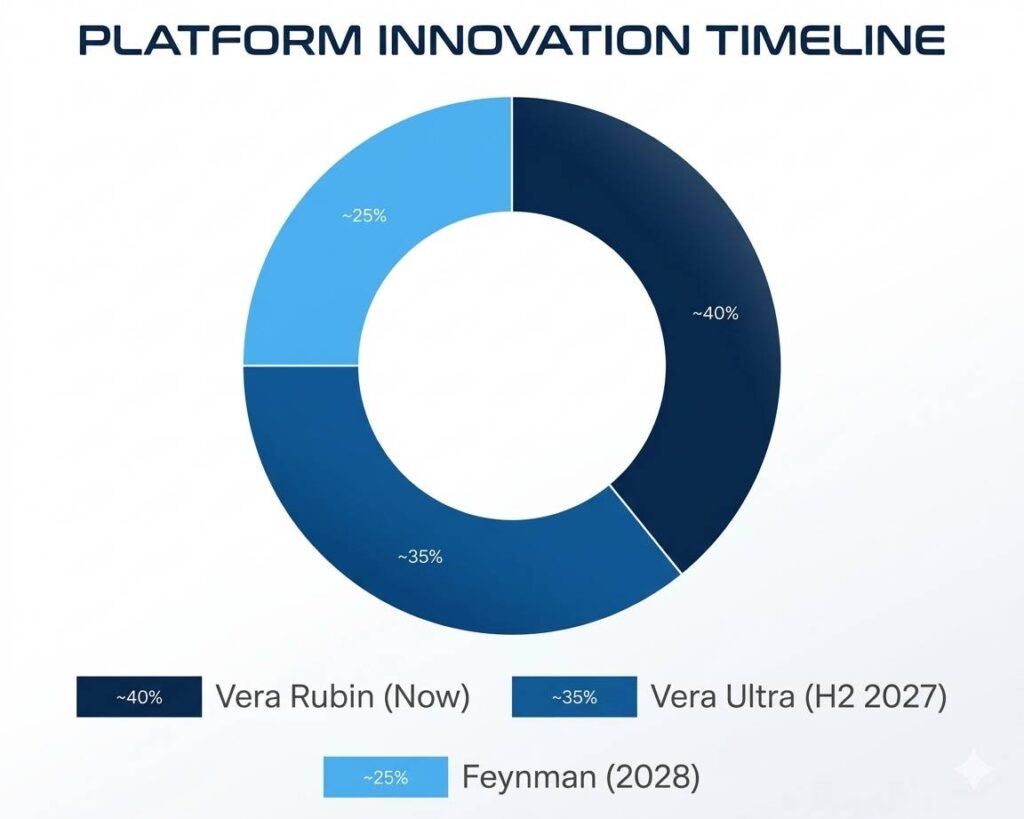
The three-generation roadmap visibility — Vera Rubin (now), Vera Ultra (H2 2027), Feynman (2028) — is NVIDIA’s most powerful competitive weapon against custom AI accelerators. Hyperscalers that commit to NVIDIA’s roadmap gain infrastructure continuity through 2028. Those that divert capital to custom silicon must invest 2-4 years in design cycles with no guaranteed performance outcome. The roadmap raises switching costs for every hyperscaler in the market.
📊 Oplexa Report: NVIDIA Strategic Inflection Analysis 2025–2035 — Full Vera Rubin, Vera Ultra & Feynman roadmap with investment implications →
What GTC 2026 Means for Investors — 5 Key Signals
- $1 Trillion backlog is a floor, not a ceiling. NVIDIA’s order backlog doubled from $500B to $1T in one year. If the pattern holds, GTC 2027 could announce a $2T backlog. Investors should treat the $1T figure as a conservative baseline.
- Physical AI opens a market larger than data centers. The global robotics and industrial automation market dwarfs the AI data center market. IGX Thor and Drive Hyperion give NVIDIA a recurring revenue foothold in manufacturing, healthcare, and automotive that could generate tens of billions annually by 2030.
- NemoClaw is the CUDA moat of the agentic era. Every enterprise that builds agents on NemoClaw deepens dependency on NVIDIA hardware. The open-source model accelerates adoption while ensuring all production deployments run on NVIDIA silicon.
- The Intel partnership diversifies supply chain risk. NVIDIA’s TSMC dependency is its most significant single point of failure. The Intel NVLink CPU partnership opens a path to Intel Foundry as a secondary manufacturing source — reducing geopolitical risk in the supply chain.
- Three-generation visibility eliminates the upgrade uncertainty discount. Historically, uncertainty about NVIDIA’s next-generation performance caused enterprise hesitation around multi-year infrastructure commitments. The Vera Rubin, Vera Ultra, and Feynman roadmap eliminates this uncertainty — and with it, a significant barrier to large-scale AI infrastructure investment.
📊 Oplexa Report: Global Semiconductor Supply Chain Risk & Forecast 2025–2035 — TSMC dependency, Intel Foundry potential & geopolitical risk analysis →
Conclusion
The GTC 2026 wrap-up tells one clear story: NVIDIA has completed its transformation from a chip company into a full-stack AI infrastructure platform. The $1 trillion order backlog, Vera Rubin shipping to Azure, NemoClaw agentic AI, Physical AI factories, and a three-generation GPU roadmap — together, these announcements define the AI infrastructure landscape through 2028.
For enterprises, GTC 2026 provides the clarity needed to commit to multi-year AI infrastructure investments. For investors, it provides the revenue visibility needed to assess NVIDIA’s growth trajectory with confidence. For the semiconductor industry, it sets a performance and economics baseline — the inference era’s cost structure, the Physical AI market’s hardware requirements, and the agentic AI software stack’s architectural foundation — that every competitor must now respond to.
GTC 2026 was not just NVIDIA’s biggest conference. It was the moment the AI industrial era officially began.
“GTC 2026 wasn’t just about new chips. It showed NVIDIA pushing to own the economics of inference, agentic AI, and the infrastructure beneath the next industrial wave.” — eWeek
Jensen Huang GTC 2026 Keynote: Everything NVIDIA Announced — Full keynote recap →
NVIDIA Intel $5B Deal: Why the AI Chip War Just Changed Forever →
Frequently Asked Questions
What were the biggest announcements at GTC 2026?
The ten biggest GTC 2026 announcements were: $1 trillion Blackwell and Vera Rubin order backlog, Vera Rubin NVL72 shipping to Azure, Groq 3 LPX rack delivering 35x token efficiency, OpenClaw and NemoClaw agentic AI platform launch, Physical AI Data Factory Blueprint open-sourced, IGX Thor generally available, Drive Hyperion expanding to five new automakers with Uber partnership, DLSS 5 with probabilistic rendering, Intel NVLink x86 CPU integration, and Vera Ultra and Feynman architecture previews.
What is the $1 trillion NVIDIA order backlog?
Jensen Huang announced at GTC 2026 that combined purchase orders for Blackwell and Vera Rubin AI infrastructure systems are expected to reach $1 trillion through 2027. This is double the $500 billion projection from GTC 2025, reflecting accelerating hyperscaler capital expenditure on AI infrastructure and broader enterprise adoption of NVIDIA’s full-stack AI platform.
What is Physical AI and why did NVIDIA focus on it at GTC 2026?
Physical AI refers to artificial intelligence embedded in physical systems — robots, autonomous vehicles, industrial machines, and medical devices — that can perceive, reason about, and act in the real world. NVIDIA focused on Physical AI at GTC 2026 because it represents a multi-trillion-dollar market opportunity that extends far beyond data centers. IGX Thor, Isaac GR00T, Cosmos 3, and the Physical AI Data Factory Blueprint together form NVIDIA’s complete platform for this market.
What is NemoClaw and how does it differ from OpenClaw?
OpenClaw is the open-source operating system layer for agentic computers — described as Android for AI agents — that runs on any NVIDIA hardware and provides always-on memory, real-time planning, and built-in safety. NemoClaw is the production-grade application layer built on OpenClaw, providing enterprise-ready tools, optimised Nemotron agent models, and governance frameworks for deploying 24/7 digital workers. Together they form NVIDIA’s complete agentic AI stack.
When does the Vera Rubin successor ship?
Vera Ultra — the mid-cycle refresh of Vera Rubin — is scheduled for the second half of 2027 with backward NVLink compatibility. Feynman, the full next-generation architecture, is expected in 2028 on TSMC’s 1.6nm A16 process node with silicon photonics interconnects. Both were previewed at GTC 2026, providing hyperscalers with three-generation visibility into NVIDIA’s GPU roadmap.